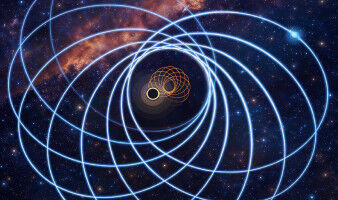
Artist’s composition of a volcanic exo-Io undergoing extreme mass loss. The hidden exomoon is enshrouded in an irradiated gas cloud shining in bright orange-yellow, as would be seen with a sodium filter. Patches of sodium clouds are seen to trail the lunar orbit, possibly driven by the gas giant’s magnetosphere. © University of Bern
A rocky extrasolar moon (exomoon) with bubbling lava may orbit a planet 550 light-years away from us. This is suggested by an international team of researchers led by the University of Bern on the basis of theoretical predictions matching observations. The "exo-Io" would appear to be an extreme version of Jupiter's moon Io. Jupiter's moon Io is the most volcanically active body in our solar system. Today, there are indications that an active moon outside our solar system, an exo-Io, could be hidden at the exoplanet system WASP-49b. "It would be a dangerous volcanic world with a molten surface of lava, a lunar version of close-in Super Earths like 55 Cancri-e" says Apurva Oza, postdoctoral fellow at the Physics Insitute of the University of Bern and associate of the NCCR PlanetS, "a place where Jedis go to die, perilously familiar to Anakin Skywalker." But the object that Oza and his colleagues describe in their work seems to be even more exotic than Star Wars science fiction: the possible exomoon would orbit a hot giant planet, which in turn would race once around its host star in less than three days - a scenario 550 light years away in the inconspicuous constellation of Lepus, underneath the bright Orion constellation. Sodium gas as circumstantial evidence.
TO READ THIS ARTICLE, CREATE YOUR ACCOUNT
And extend your reading, free of charge and with no commitment.
Your Benefits
- Access to all content
- Receive newsmails for news and jobs
- Post ads