The minute hand of this watch prototype is made of glass and filled with a fluorescent liquid. Image: Ulysse Nardin
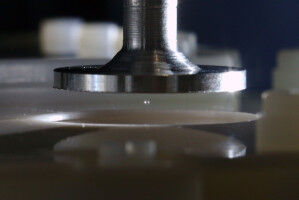
Can glass flow at room temperature and thus withstand hard impacts' A theory from the 1970s predicted exactly this. Empa researchers have now provided the proof. The results could form the basis for robust 3D printed glass microarchitectures. No one in the world has ever seen what we have measured," says Rajaprakash Ramachandramoorthy. "We've tracked the breaking properties of glass further than any previous research team." Raj - his nickname among colleagues - works in the Empa lab "Mechanics of Materials and Nanostructures" led by Johann Michler. The team explores material properties on a very small scale: Machines they have developed themselves use tiny stamps to press columns just a few micrometres thin, so-called micropillars. In the electron microscope, and with the help of the most precise force measurements, they can observe how the micropillar breaks or deforms.
TO READ THIS ARTICLE, CREATE YOUR ACCOUNT
And extend your reading, free of charge and with no commitment.