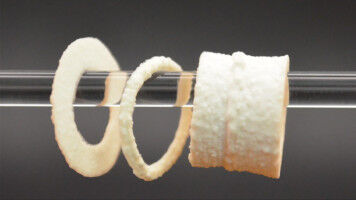
Sophisticated modelling technology opens up new avenues in timber construction and digital design. [Picture: ICD/ITKE]
Researchers from the University of Stuttgart, ETH Zurich and the Swiss Empa have presented a method with which wood panels themselves bend into a previously calculated shape in a controlled drying process without mechanical force. The procedure, which contributed to the production of the Urbach Tower at the Remstal Garden Show near Stuttgart, was reported on by the renowned scientific journal Science Advances in its issue of 13 September 2019. Self-forming mechanisms can be found in nature, for example in plants that change their shape automatically in a season to release their seeds. These changes occur without mechanical or electrical influence in both two and three-dimensional directions. If, on the other hand, wood is to be deformed into curved or twisted structures, large and energy-intensive machines and formwork are required to press the components into the desired shape. In the study published in Science Advances, researchers from the University of Stuttgart, ETH Zurich and Empa are now showing how structurally valuable curved geometries could be used in the future while avoiding complex and wastefully mechanical forming processes. Together, they have developed an approach in which solid wood building components bend into a predefined shape without the application of external forces.
TO READ THIS ARTICLE, CREATE YOUR ACCOUNT
And extend your reading, free of charge and with no commitment.