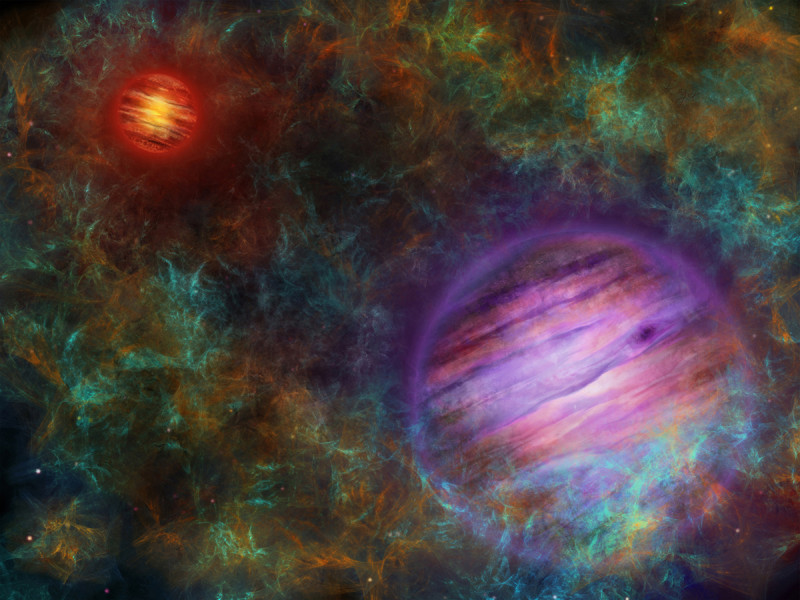
 Artist’s composition of the two brown dwarfs, in the foreground Oph 98B in purple, in the background Oph 98A in red. Oph 98A is the more massive and therefore more luminous and hotter of the two. The two objects are surrounded by the molecular cloud in which they were formed. © University of Bern
Artist's composition of the two brown dwarfs, in the foreground Oph 98B in purple, in the background Oph 98A in red. Oph 98A is the more massive and therefore more luminous and hotter of the two. The two objects are surrounded by the molecular cloud in which they were formed. University of Bern , Illustration: Thibaut Roger - An international research team led by the University of Bern has discovered an exotic binary system composed of two young planet-like objects, orbiting around each other from a very large distance. Although these objects look like giant exoplanets, they formed in the same way as stars, proving that the mechanisms driving star formation can produce rogue worlds in unusual systems deprived of a Sun. Star-forming processes sometimes create mysterious astronomical objects called brown dwarfs, which are smaller and colder than stars, and can have masses and temperatures down to those of exoplanets in the most extreme cases. Just like stars, brown dwarfs often wander alone through space, but can also be seen in binary systems, where two brown dwarfs orbit one another and travel together in the galaxy.
TO READ THIS ARTICLE, CREATE YOUR ACCOUNT
And extend your reading, free of charge and with no commitment.
Your Benefits
- Access to all content
- Receive newsmails for news and jobs
- Post ads