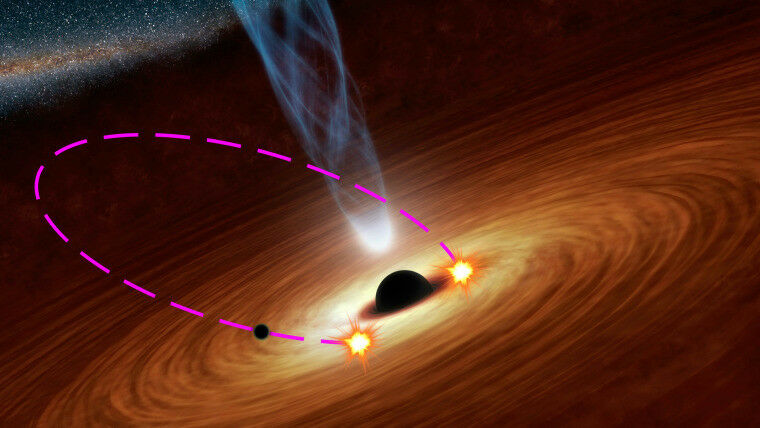
Artistic illustration of the centre of OJ 287, in which two black holes orbit each other. Picture: NASA/JPL-Caltech
Artistic illustration of the centre of OJ 287, in which two black holes orbit each other. Picture: NASA/JPL-Caltech - International research team verifies the validity of the "No Hair" theorem by actual observations Light With the help of NASA's Spitzer Space Telescope, an international team of researchers has confirmed that the cosmic object OJ 287 is a distant galaxy with a binary system of two supermassive black holes in its centre, which are orbiting each other. With the measurement data that the scientists present in today's issue of the "Astrophysical Journal Letters" , they also verify the "no-hair" theorem of black holes. Astrophysicists from the Friedrich Schiller University Jena are among the authors of the study. It took more than 100 years until the existence of gravitational waves predicted by Albert Einstein in 1915 as part of his general theory of relativity was finally proven in an experiment. The first observation of gravitational wave signals in 2015, resulting from the merger of two stellar black holes, marked the beginning of the era of gravitational wave astronomy. Now, astrophysicists want to write a new chapter and detect gravitational waves in the nanohertz range, which e.g. supermassive black holes orbiting one another create, long before they collide.
TO READ THIS ARTICLE, CREATE YOUR ACCOUNT
And extend your reading, free of charge and with no commitment.