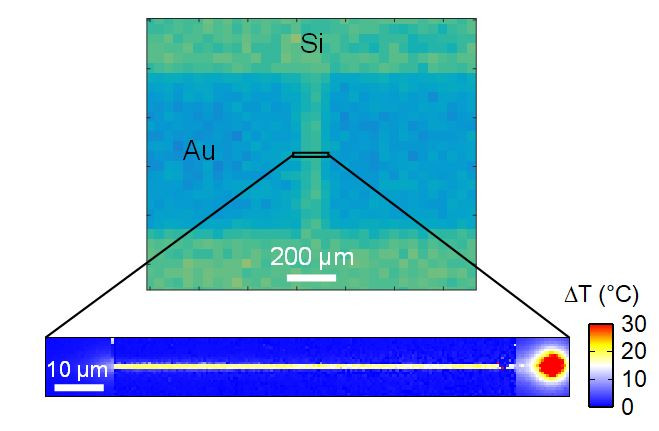
 Temperature map of a gold nanowire on a silicon substrate, Joule-heated by the application of an electrical current of 7 mA, obtained through infrared thermography (top) and a spin-crossover surface thermometer (bottom). While heating remains undetectable in infrared due to low thermal and spatial resolution, temperature distribution is well resolved using an SCO-based thermometer, which reveals a ’hot spot’ resulting from a malfunction of the component.
Temperature map of a gold nanowire on a silicon substrate, Joule-heated by the application of an electrical current of 7 mA, obtained through infrared thermography ( top ) and a spin-crossover surface thermometer ( bottom ). While heating remains undetectable in infrared due to low thermal and spatial resolution, temperature distribution is well resolved using an SCO-based thermometer, which reveals a 'hot spot' resulting from a malfunction of the component. Ridier et al. Scientists from the Coordination Chemistry Laboratory and Laboratory for Analysis and Architecture of Systems, both of the CNRS, recently developed molecular films that can measure the operating temperature of electronic components on a nanometric scale. These patented temperature-sensitive molecules have the distinctive quality of being extremely stable, even after millions of uses. They were presented in an article published on 17 July 2020, and could soon be deployed in the microelectronics industry. The miniaturisation of electronic components coupled with their increasing integration density has considerably expanded heat flows, which can lead to overheating.
TO READ THIS ARTICLE, CREATE YOUR ACCOUNT
And extend your reading, free of charge and with no commitment.
Your Benefits
- Access to all content
- Receive newsmails for news and jobs
- Post ads