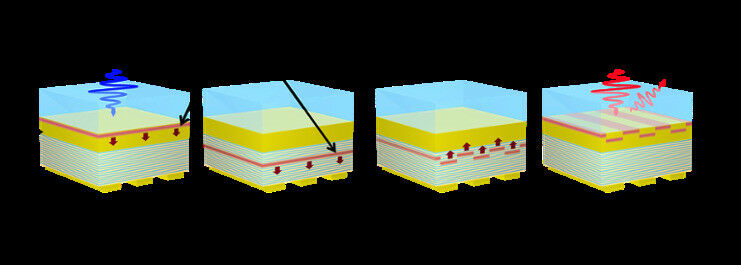
A femtosecond pump laser ’knocks’ at the opaque material (1), causing a high frequency acoustic wave to travel through the layers (2) until it reaches the buried grating lines. The acoustic waves are reflected at the grating and travel back (3) as a grating shaped wave. When this wave hits the surface (4), the grating shaped deformation can be detected from the diffraction signal of a femtosecond probe laser.
A femtosecond pump laser 'knocks' at the opaque material (1) , causing a high frequency acoustic wave to travel through the layers (2) until it reaches the buried grating lines. The acoustic waves are reflected at the grating and travel back (3) as a grating shaped wave. When this wave hits the surface (4), the grating shaped deformation can be detected from the diffraction signal of a femtosecond probe laser. Researchers at ARCNL have found a way to detect nanostructures buried under many layers of opaque material, using very high frequency sound waves induced by light. Their findings are promising in view of applications in the semiconductor manufacturing industry, such as wafer alignment. The researchers also revealed interesting new phenomena in photo-acoustics that have not been investigated before. They will publish their results in Physical Review Applied on 7 July.
TO READ THIS ARTICLE, CREATE YOUR ACCOUNT
And extend your reading, free of charge and with no commitment.