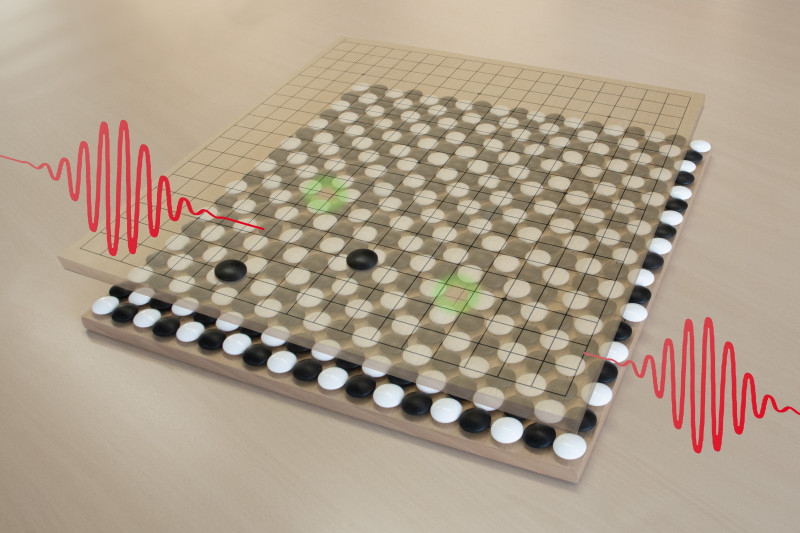
1/2 images The Pi-ton Two electrons and two holes, created by light quanta, held together by a chessboard-like background Two electrons and two holes, created by light quanta, held together by a chessboard-like background
1/2 images The Pi-ton Two electrons and two holes, created by light quanta, held together by a chessboard-like background Two electrons and two holes, created by light quanta, held together by a chessboard-like background - Actually they had been looking for something completely different, but they found a previously unknown quasi-particle: A bound state of two electrons, two holes and light. In physics, there are very different types of particles: Elementary particles are the fundamental building blocks of matter. Other particles, such as atoms, are bound states consisting of several smaller constituents. And then there are so-called "quasi-particles" - excitations in a system that consists of many particles, which in many ways behave just like a particle themselves. Such a quasiparticle has now been discovered in computer simulations at TU Wien (Vienna) and named pi-ton. It consists of two electrons and two holes. The new particle is presented in the journal "Physical Review Letters", the article also describes how the pi-ton can be detected experimentally.
TO READ THIS ARTICLE, CREATE YOUR ACCOUNT
And extend your reading, free of charge and with no commitment.