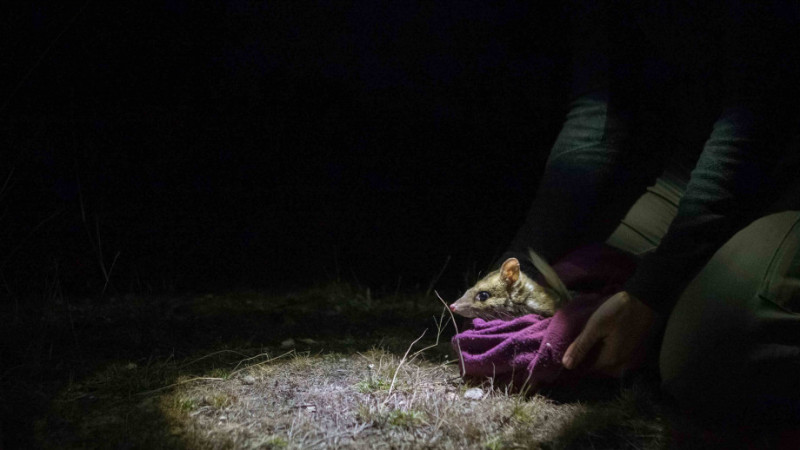
Photo credit: Lannon Harley, ANU
Photo credit: Lannon Harley, ANU - An experimental research project led by researchers from The Australian National University (ANU) has found a new way to boost the survival rates of eastern quolls reintroduced to the Australian Capital Territory. The eastern quoll, a small carnivorous marsupial, was once widespread in southeastern Australia. Last seen on the mainland in 1967, eastern quolls became extinct due to predation by introduced foxes and cats, habitat loss, disease, accidental poisoning, and deliberate interference by humans. Luckily, populations persisted in Tasmania. According to PhD scholar Belinda Wilson, the first quolls reintroduced to the Mulligans Flat Woodland Sanctuary in 2016 had a survival rate of only 29 per cent. "Through a novel and adaptive approach, we were able to boost survival to 77 per cent in the second trial, and then to 88 percent by the third trial," Ms Wilson said. "In 2016 we released both males and females, but most of the males escaped the sanctuary fence and were killed by foxes. "In the second release, we trialled releasing only mothers with small pouch young.
TO READ THIS ARTICLE, CREATE YOUR ACCOUNT
And extend your reading, free of charge and with no commitment.