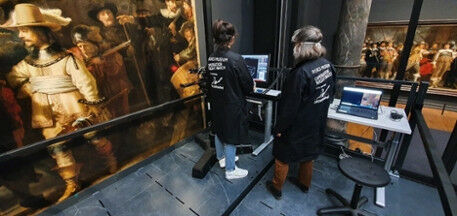
Erma Hermens and Mitra Almasian of the UMC are working with Optical Coherence Tomography, an imaging technique they are using to research the usage of the blue pigment smalt.
Erma Hermens and Mitra Almasian of the UMC are working with Optical Coherence Tomography, an imaging technique they are using to research the usage of the blue pigment smalt. The summer of 2019 saw the kick-off of the largest and most multifaceted research project ever to focus on Rembrandt's famous painting The Night Watch. Ever since the museum reopened after its closure earlier this year following coronavirus measures, the team has been working under adapted conditions. Despite this, the researchers are getting closer and closer to the painter and his creative process, says Erma Hermens, Rijksmuseum Professor of Studio Practice and Technical Art History. A team of more than twenty Rijksmuseum conservators, curators, scientists and photographers collaborates in Operation Night Watch in order to gain insight into the changes Rembrandt's masterpiece, which he completed in 1642, has undergone. This will allow for the painting's current condition to be better understood and for it to be preserved for future generations in the best possible way. To the visiting public, the project moreover has an added dimension: a glass chamber has been placed around the painting, so that museum visitors can take a look at the ongoing research and conservation process.
TO READ THIS ARTICLE, CREATE YOUR ACCOUNT
And extend your reading, free of charge and with no commitment.