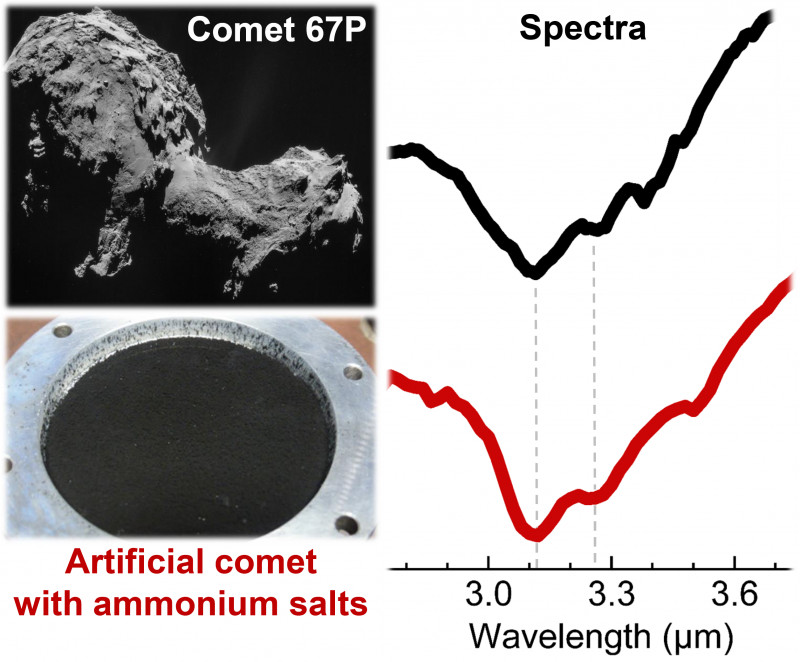
Comparison of the spectrum of the artificial comet containing ammonium salt (in red) with the spectrum of the surface of the comet ’Chury’ (in black). The core of the comet is about 4 km long (top left image; credits: ESA/Rosetta/NAVCAM - CC BY-SA IGO 3.0 The artificial comet is produced in the laboratory in a 5 cm diameter container (bottom left image; credits: Poch et al., 2020).
Comparison of the spectrum of the artificial comet containing ammonium salt ( in red ) with the spectrum of the surface of the comet 'Chury' ( in black ). The core of the comet is about 4 km long (top left image; credits: ESA/Rosetta/NAVCAM - CC BY-SA IGO 3. The artificial comet is produced in the laboratory in a 5 cm diameter container (bottom left image; credits: Poch et al. One of the basic building blocks of life is nitrogen. An international consortium was able to detect ammonium salt containing nitrogen on the cometary surface of Chury thanks to a method using analogues for comet material. The method on which the study on the detection of ammonium salt is based was developed at the University of Bern. Comets and asteroids are objects in our solar system that have not developed much since the planets were formed.
TO READ THIS ARTICLE, CREATE YOUR ACCOUNT
And extend your reading, free of charge and with no commitment.