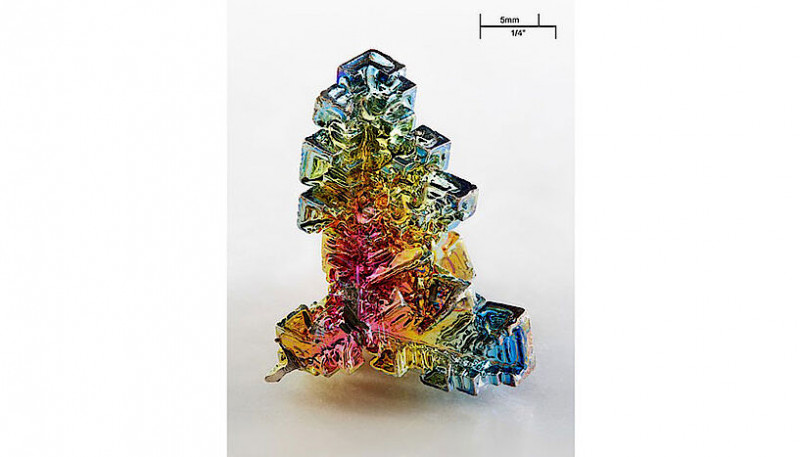
 The chemical element bismuth as a synthetic made crystal. The surface is an iridescent very thin layer of oxidation.
The chemical element bismuth as a synthetic made crystal. The surface is an iridescent very thin layer of oxidation. Alchemist-hp / CC BY-SA 3. International research team describes the new possibilities offered by the use of ultracold dipolar atoms The quantum properties underlying crystal formation can be replicated and investigated with the help of ultracold atoms. A team led by Dr. Axel U. J. Lode from the University of Freiburg's Institute of Physics has now described in the journal Physical Review Letters how the use of dipolar atoms enables even the realization and precise measurement of structures that have not yet been observed in any material. The theoretical study was a collaboration involving scientists from the University of Freiburg, the University of Vienna and the Technical University of Vienna in Austria, and the Indian Institute of Technology in Kanpur, India. Crystals are ubiquitous in nature. They are formed by many different materials - from mineral salts to heavy metals like bismuth. Their structures emerge because a particular regular ordering of atoms or molecules is favorable, because it requires the smallest amount of energy. A cube with one constituent on each of its eight corners, for instance, is a crystal structure that is very common in nature. A crystal's structure determines many of its physical properties, such as how well it conducts a current or heat or how it cracks and behaves when it is illuminated by light. But what determines these crystal structures?
TO READ THIS ARTICLE, CREATE YOUR ACCOUNT
And extend your reading, free of charge and with no commitment.
Your Benefits
- Access to all content
- Receive newsmails for news and jobs
- Post ads