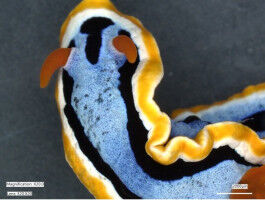
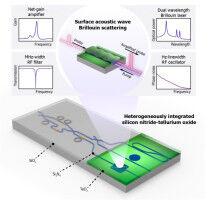
Artist’s impression of the phase transition of indium atoms on a silicon crystal controlled by light pulses Photo: Dr Murat Sivis
Artist's impression of the phase transition of indium atoms on a silicon crystal controlled by light pulses Photo: Dr Murat Sivis Göttingen Physicists use oscillations of atoms to control a phase transition The goal of -Femtochemistry- is to film and control chemical reactions with short flashes of light. Using consecutive laser pulses, atomic bonds can be excited precisely and broken as desired. So far, this has been demonstrated for selected molecules. Researchers at the University of Göttingen and the Max Planck Institute for Biophysical Chemistry have now succeeded in transferring this principle to a solid, controlling its crystal structure on the surface. The team, led by Jan Gerrit Horstmann and Professor Claus Ropers, evaporated an extremely thin layer of indium onto a silicon crystal and then cooled the crystal down to -220 degrees Celsius. While the indium atoms form conductive metal chains on the surface at room temperature, they spontaneously rearrange themselves into electrically insulating hexagons at such low temperatures. This process is known as the transition between two phases - the metallic and the insulating - and can be switched by laser pulses.
TO READ THIS ARTICLE, CREATE YOUR ACCOUNT
And extend your reading, free of charge and with no commitment.