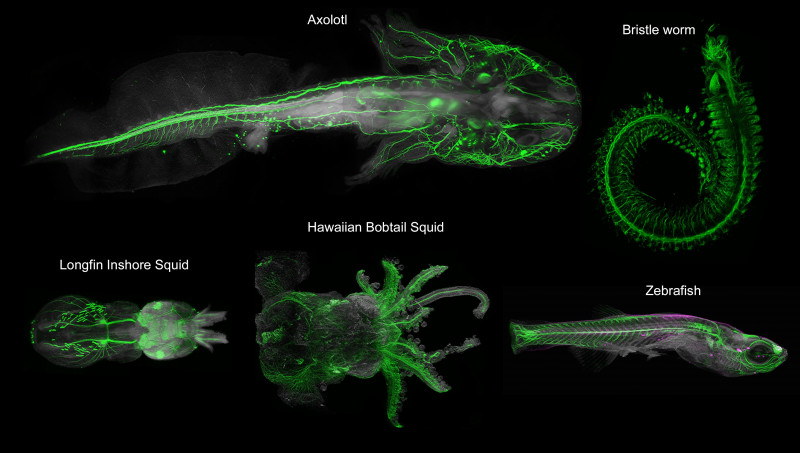
1/4 images Processed Animals Light-sheet imges of different DEEP-Clear processed animals labelled with neurosystem specific markers. (Copyright TU Wien / Max Perutz Labs) Light-sheet imges of different DEEP-Clear processed animals labelled with neurosystem specific markers. (Copyright TU Wien / Max Perutz Labs)
1/4 images Processed Animals Light-sheet imges of different DEEP-Clear processed animals labelled with neurosystem specific markers. (Copyright TU Wien / Max Perutz Labs) Light-sheet imges of different DEEP-Clear processed animals labelled with neurosystem specific markers. (Copyright TU Wien / Max Perutz Labs) - Advances in neuroscience research and microscopy: Researchers look deep into organs and nervous systems of animals, ranging from squids and worms to fish and salamanders. Analyses of individual cells in the context of whole organs or tissues is becoming increasingly important in biology. A standard approach so far was to cut larger tissues into thin layers, study each of these sections, and then piece the information again together into a 3D model. However, this is a laborious process, and often yields incomplete results. For instance, the cells that make up our nervous systems possess long extensions that can reach through the entire body.
TO READ THIS ARTICLE, CREATE YOUR ACCOUNT
And extend your reading, free of charge and with no commitment.