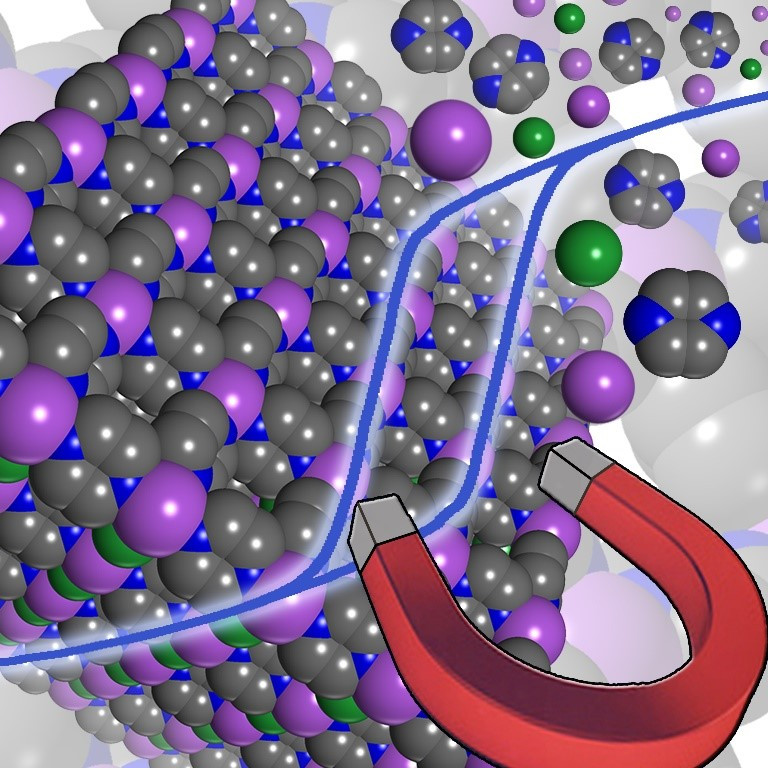
 Pictorial representation of the molecule-based magnet and its magnetic properties.
Pictorial representation of the molecule-based magnet and its magnetic properties. ©Rodolphe Clérac - Magnets are to be found everywhere in our daily lives, whether in satellites, telephones or on fridge doors. However, they are made up of heavy inorganic materials whose component elements are, in some cases, of limited availability. Now, researchers from the CNRS, the University of Bordeaux and the ESRF (European Synchrotron Radiation Facility in Grenoble) 1 have developed a new lightweight molecule-based magnet, produced at low temperatures, and exhibiting unprecedented magnetic properties. This compound, derived from coordination chemistry 2 , contains chromium, an abundant metal, and inexpensive organic molecules. This is the first molecule-based magnet that exhibits a 'memory effect' (i.e. it is capable of maintaining one of its two magnetic states) up to a temperature of 240 °C.
TO READ THIS ARTICLE, CREATE YOUR ACCOUNT
And extend your reading, free of charge and with no commitment.
Your Benefits
- Access to all content
- Receive newsmails for news and jobs
- Post ads