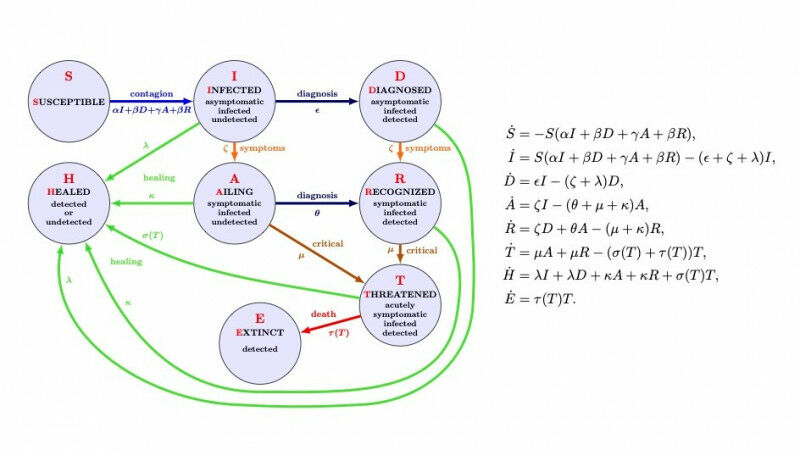
An algorithm from the University of Stuttgart determines when social distancing is necessary and to what extent. [Picture: Inspired by Giordano et al., 2020.]
An algorithm from the University of Stuttgart determines when social distancing is necessary and to what extent. Picture: Inspired by Giordano et al. In order to keep the rate of new infections in the Covid-19 epidemic low and at the same time limit the negative consequences on social and economic life, protective measures should be adapted to the respective case numbers. But what restrictions are necessary, and which lockdown regulations can be relaxed? This is difficult to estimate due to the uncertain and dynamic data situation and the complexity of the spreading and the measures. Researchers at the University of Stuttgart have now developed a computational model with which adaptive measures can be determined much more reliably when there is uncertainty. In a recently published paper, a research team led by Prof. Frank Allgöwer, Head of the Institute for Systems Theory and Automatic Control (IST) at the University of Stuttgart, and member of the Cyber Valley research network as well as Deputy Director and Spokesperson of the EXC 2075 "Data-Integrated Simulation Science" Cluster of Excellence, analyzes the Covid-19 epidemic in Germany using control engineering methods. The team is developing strategies that provide information on when social distancing is necessary and to what extent.
TO READ THIS ARTICLE, CREATE YOUR ACCOUNT
And extend your reading, free of charge and with no commitment.