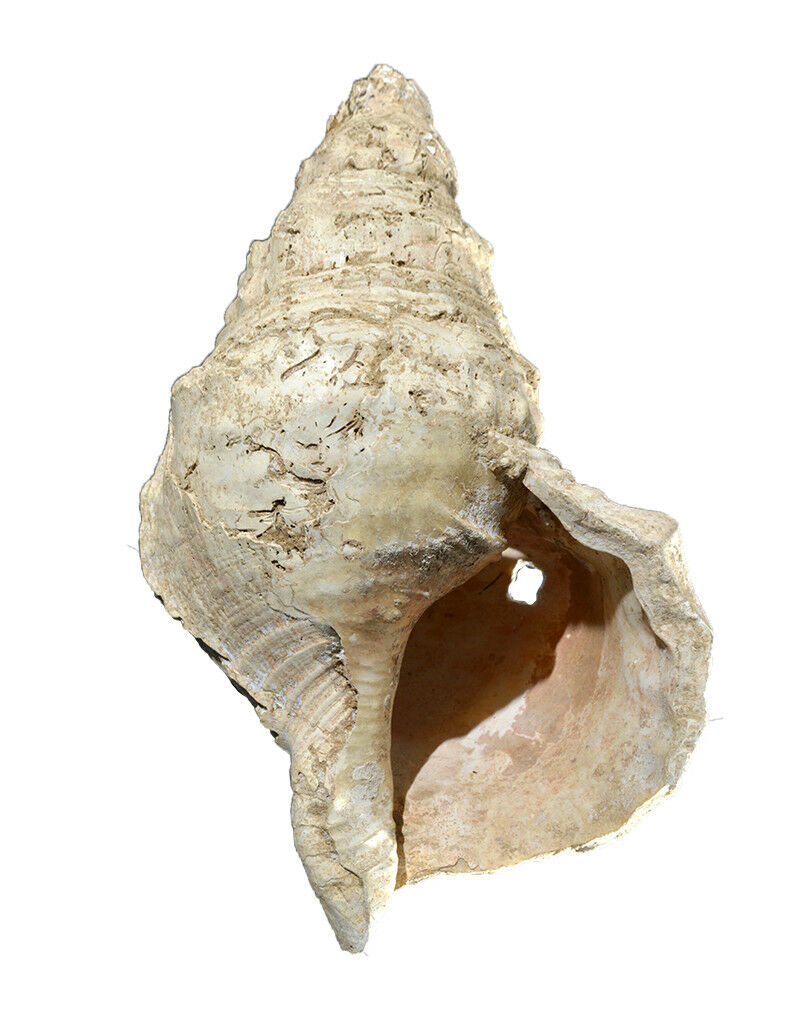
 At 31 cm in height, 18 cm in diameter (at the widest point) and up to 0.8 cm thick, this conch, which bears witness to a colder sea, is thus larger and thicker than more recent ones.
At 31 cm in height, 18 cm in diameter (at the widest point) and up to 0.8 cm thick, this conch, which bears witness to a colder sea, is thus larger and thicker than more recent ones. © Carole Fritz et al. Almost 80 years after its discovery, a large shell from the ornate Marsoulas Cave in the Pyrenees has been studied by a multidisciplinary team from the CNRS, the Muséum de Toulouse, the Université Toulouse - Jean Jaurès and the Musée du quai Branly - Jacques-Chirac 1 : it is believed to be the oldest wind instrument of its type. Scientists reveal how it sounds in a study published in the journal Science Advances on 10th February 2021. The laboratoires involved are the Travaux et recherches archéologiques sur les cultures, les espaces et les sociétés (CNRS/Université Toulouse - Jean Jaurès/Ministère de la Culture), the Maison des sciences de l'homme et de la société de Toulouse (CNRS/Université Fédérale de Toulouse) and the Laboratoire d'archéologie moléculaire et structurale (CNRS/Sorbonne Université). The Marsoulas Cave, between Haute-Garonne and Ariège, was the first decorated cave to be found in the Pyrenees. Discovered in 1897, the cave bears witness to the beginning of the Magdalenian 2 culture in this region, at the end of the Last Glacial Maximum.
TO READ THIS ARTICLE, CREATE YOUR ACCOUNT
And extend your reading, free of charge and with no commitment.
Your Benefits
- Access to all content
- Receive newsmails for news and jobs
- Post ads