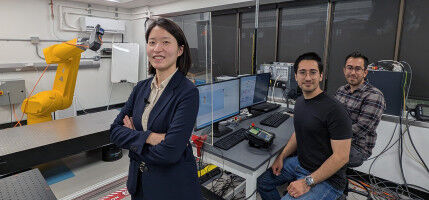
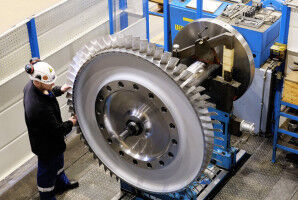
Wind tunnel experiment using particle image velocimetry technique. UC3M
Wind tunnel experiment using particle image velocimetry technique. UC3M - Developing new ways to measure turbulent flows that are more efficient and reliable is the main objective of the NEXTFLOW research project at the Universidad Carlos III de Madrid (UC3M), funded by an ERC Starting Grant from the European Union. These techniques, which use new developments in artificial intelligence and data mining, can be used to improve the aerodynamics of means of transport and reduce their environmental impact. One of the current challenges that aerodynamics faces is improving techniques for characterising and controlling the behaviour of turbulent flows (the fluid motion that occurs around an airplane wing, for example). "They are chaotic, with complex dynamics which makes it difficult to understand their behaviour completely using the techniques currently available to us," explains the NEXTFLOW project coordinator, Stefano Discetti, from the UC3M's Department of Bioengineering and Aerospace Engineering. Optimising strategies to measure turbulent flows is a key element in today's industry due to the critical role that turbulence plays in many industrial applications. In this regard, obtaining more precise information about its dynamics would allow us to use it in real-life contexts, such as in the transport sector.
TO READ THIS ARTICLE, CREATE YOUR ACCOUNT
And extend your reading, free of charge and with no commitment.