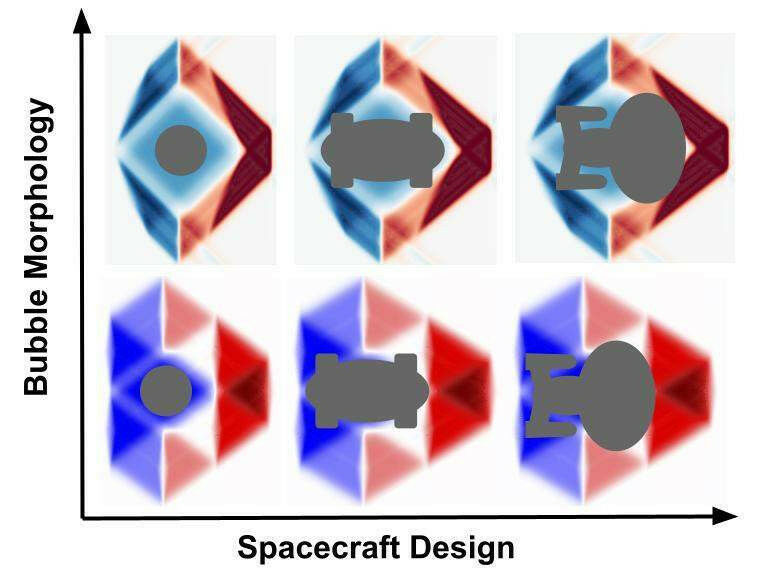
Artistic impression of different spacecraft designs considering theoretical shapes of different kinds of ’warp bubbles’. Photo: E Lentz
Artistic impression of different spacecraft designs considering theoretical shapes of different kinds of 'warp bubbles'. Photo: E Lentz Astrophysicist at Göttingen University discovers new theoretical hyper-fast soliton solutions If travel to distant stars within an individual's lifetime is going to be possible, a means of faster-than-light propulsion will have to be found. To date, even recent research about superluminal (faster-than-light) transport based on Einstein's theory of general relativity would require vast amounts of hypothetical particles and states of matter that have -exotic- physical properties such as negative energy density. This type of matter either cannot currently be found or cannot be manufactured in viable quantities. In contrast, new research carried out at the University of Göttingen gets around this problem by constructing a new class of hyper-fast -solitons- using sources with only positive energies that can enable travel at any speed. This reignites debate about the possibility of faster-than-light travel based on conventional physics. The research is published in the journal Classical and Quantum Gravity.
TO READ THIS ARTICLE, CREATE YOUR ACCOUNT
And extend your reading, free of charge and with no commitment.