 Topological isolator as a multiplexer
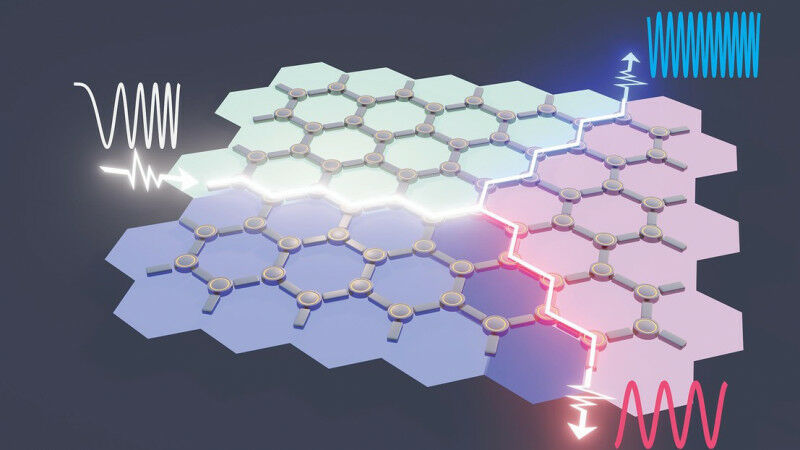
Topological isolator as a multiplexer © Zhe Zhang / EPFL 2021 - Scientists have developed a topology-based method that forces microwave photons to travel along a one way path, despite unprecedented levels of disorder and obstacles on their way. This discovery paves the way to a new generation of high-frequency circuits and extremely robust, compact communication devices. Topological insulators are materials whose structure forces photons and electrons to move only along the material's boundary and only in one direction. These particles experience very little resistance and travel freely past obstacles such as impurities, fabrication defects, a change of signal's trajectory within a circuit, or objects placed intentionally in the particles' path. That's because these particles, instead of being reflected by the obstacle, go around it "like river-water flowing past a rock," says Prof. Romain Fleury, head of EPFL's Laboratory of Wave Engineering, within the School of Engineering. Until now, these particles' exceptional resilience to obstacles applied only to limited perturbations in the material, meaning this property couldn't be exploited widely in photonics-based applications. However, that could soon change thanks to research being conducted by Prof. Fleury along with his PhD candidate Zhe Zhang and Pierre Delplace from the ENS Lyon Physics Laboratory.
TO READ THIS ARTICLE, CREATE YOUR ACCOUNT
And extend your reading, free of charge and with no commitment.
Your Benefits
- Access to all content
- Receive newsmails for news and jobs
- Post ads