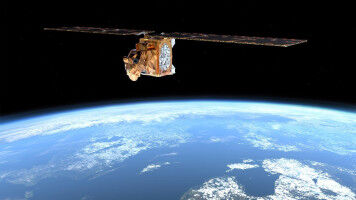
Artistic rendering. Image credit: M.Weiss/Center for Astrophysics | Harvard & Smithsonian
Artistic rendering. Image credit: M.Weiss/Center for Astrophysics | Harvard & Smithsonian New ALMA study reveals the many molecular faces of protoplanetary disks Scientists connect the dots between where planets form and what they're made of An international group of scientists, including University of Michigan astronomers, has mapped the chemical composition of protoplanetary disks surrounding five nearby young stars-an effort that will allow the astronomers to search the disks for planet formation in real time. The survey provides the most detailed pictures of planet-forming gases to date, which will help scientists understand how planets form, ranging from gas giants called hot Jupiters to our own life-sustaining planet. "The goal of this program was to survey the chemistry of planet formation with the highest resolution possible in a limited amount of time-just 130 hours. We wanted to know how planets are born and what sets their composition at birth,” said Edwin Bergin , U-M professor of astronomy, co-principal investigator of the survey and co-author on the papers. "This can then be compared to the composition of exoplanetary atmospheres and in solar system planets to understand how common Jupiters are and, eventually, life-bearing worlds like the Earth. The collaboration used the Atacama Large Millimeter/submillimeter Array , or ALMA, to complete the most extensive chemical composition mapping of the protoplanetary disks at high resolution that allows scientists to probe the makeup of their planetand comet-forming regions.
TO READ THIS ARTICLE, CREATE YOUR ACCOUNT
And extend your reading, free of charge and with no commitment.