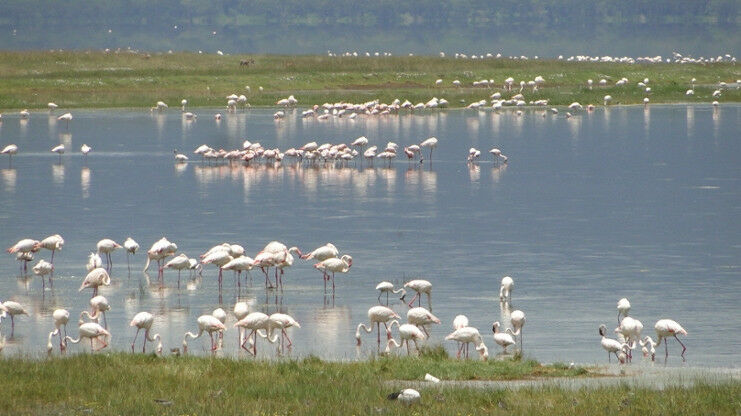
The alkaline Nakuru Lake in Kenya is rich in the cyanobacterium Spirulina platensis, the basic food of the Lesser Flamingo. However, due to increasing rainfall in the region in recent years, the bacterium and with it the flamingos are disappearing. Credit: Prof. Martin Trauth, University of Potsdam.
The alkaline Nakuru Lake in Kenya is rich in the cyanobacterium Spirulina platensis, the basic food of the Lesser Flamingo. However, due to increasing rainfall in the region in recent years, the bacterium and with it the flamingos are disappearing. Credit: Prof. Martin Trauth, University of Potsdam. A scientific consortium has found that ancient El Niño-like weather patterns were the primary drivers of environmental change in sub-Saharan Africa over the last 620 thousand years - the critical timeframe for the evolution of our species. The group, including Dr William Gosling from the University of Amsterdam, found that these ancient weather patterns had more profound impacts in sub-Saharan Africa than glacial-interglacial cycles more commonly linked to human evolution. While it is widely accepted that climate change drove the evolution of our species in Africa, the exact character of that climate change and its impacts are not well understood. Glacial-interglacial cycles strongly impact patterns of climate change in many parts of the world, and were also assumed to regulate environmental changes in Africa during the critical period of human evolution over the last ~1 million years.
TO READ THIS ARTICLE, CREATE YOUR ACCOUNT
And extend your reading, free of charge and with no commitment.