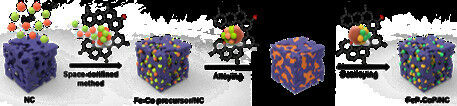
Schematic representation of the preparation of the microstructured FeP-CoP embedded nitrogen doped carbon electrocatalyst that is at the heart of the new electrolyser. Image: HIMS.
Schematic representation of the preparation of the microstructured FeP-CoP embedded nitrogen doped carbon electrocatalyst that is at the heart of the new electrolyser. Image: HIMS. High application potential thanks to robust cycling operation and use of abundant catalyst In a recent Nature Communications paper, a group of researchers led by Dr Ning Yan of the Van 't Hoff Institute for Molecular Sciences at the University of Amsterdam showcases a practical membrane-free approach to water electrolysis using earth-abundant catalysts. Their new electrolyser concept, developed together with researchers from Wuhan University and Wuhan University of Technology, offers significant advantages over electrolysers that are currently being developed for large-scale hydrogen production. The transition to a hydrogen economy is a must for advancing sustainable energy practices as well as for tackling climate change. Hydrogen that is produced through water electrolysis using renewable electricity can be used both as a clean energy carrier and as a reagent for making bulk chemicals from CO2. Large-scale water electrolysis is an essential technology for realising these goals.
TO READ THIS ARTICLE, CREATE YOUR ACCOUNT
And extend your reading, free of charge and with no commitment.