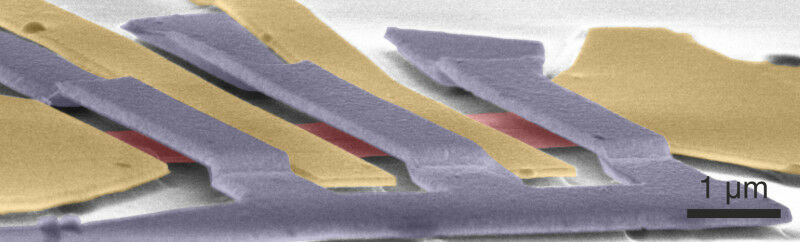
Scanning electron microscope image of a contacted, two-atom-thick, free-floating graphene flake with a free-floating metal bridge hovering above it. Photo: Fabian Geisenhof/Jakob Lenz
Scanning electron microscope image of a contacted, two-atom-thick, free-floating graphene flake with a free-floating metal bridge hovering above it. Photo: Fabian Geisenhof/Jakob Lenz International research team led by University of Göttingen finds atomically-thin carbon generates its own magnetic field Usually, the electrical resistance of a material depends very much on its physical dimensions and fundamental properties. Under special circumstances, however, this resistance can adopt a fixed value that is independent of the basic material properties and "quantised" (meaning that it changes in discrete steps rather than continuously). This quantisation of electrical resistance normally occurs within strong magnetic fields and at very low temperatures when electrons move in a two-dimensional fashion. Now, a research team led by the University of Göttingen has succeeded in demonstrating this effect at low temperatures in the almost complete absence of a magnetic field in naturally occurring double-layer graphene, which is just two atoms thick. The results of The team from the University of Göttingen, Ludwig Maximilian University of Munich and the University of Texas (Dallas) used two-layer graphene in its natural form. The delicate graphene flakes are contacted using standard microfabrication techniques and the flake is positioned so that it is hangs freely like a bridge, held at the edges by two metal contacts.
TO READ THIS ARTICLE, CREATE YOUR ACCOUNT
And extend your reading, free of charge and with no commitment.