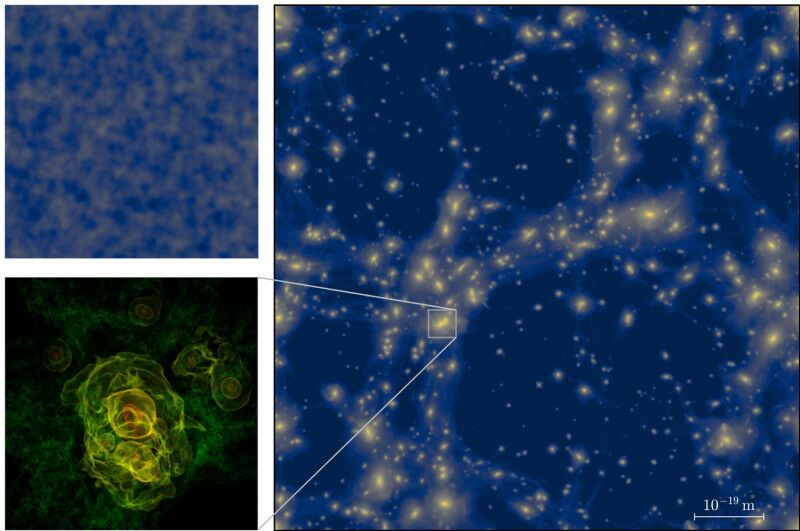
The results of the simulation show the growth of tiny, extremely dense structures very soon after the inflation phase of the very early universe. Between the initial and final states in the simulation (top left and right respectively), the area shown has expanded to ten million times its initial volume, but is still many times smaller than the interior of a proton. The enlarged clump at the bottom left would have a mass of about 20kg. Photo: Jens Niemeyer, University of Göttingen
The results of the simulation show the growth of tiny, extremely dense structures very soon after the inflation phase of the very early universe. Between the initial and final states in the simulation (top left and right respectively), the area shown has expanded to ten million times its initial volume, but is still many times smaller than the interior of a proton. The enlarged clump at the bottom left would have a mass of about 20kg. Photo: Jens Niemeyer, University of Göttingen Astrophysicists at the Universities of Göttingen and Auckland simulate microscopic clusters from the Big Bang The very first moments of the Universe can be reconstructed mathematically even though they cannot be observed directly. Physicists from the Universities of Göttingen and Auckland (New Zealand) have greatly improved the ability of complex computer simulations to describe this early epoch. They discovered that a complex network of structures can form in the first trillionth of a second after the Big Bang. The behaviour of these objects mimics the distribution of galaxies in today's Universe.
TO READ THIS ARTICLE, CREATE YOUR ACCOUNT
And extend your reading, free of charge and with no commitment.