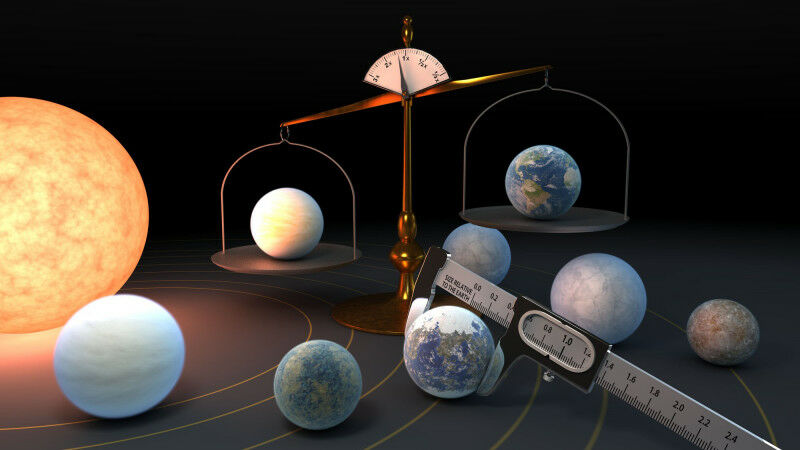
 An artist’s view of the TRAPPIST-1 system. The TRAPPIST-1 star is home to the largest batch of roughly Earth-size planets ever found outside our solar system. An international study involving researchers from the Universities of Bern, Geneva and Zurich now shows that the exoplanets have remarkably similar densities, which provides clues about their composition.
An artist's view of the TRAPPIST-1 system. The TRAPPIST-1 star is home to the largest batch of roughly Earth-size planets ever found outside our solar system. An international study involving researchers from the Universities of Bern, Geneva and Zurich now shows that the exoplanets have remarkably similar densities, which provides clues about their composition. NASA/JPL-Caltech - The TRAPPIST-1 star is home to the largest batch of roughly Earth-size planets ever found outside our solar system. An international study involving researchers from the Universities of Bern, Geneva and Zurich now shows that the exoplanets have remarkably similar densities, which provides clues about their composition. Discovered in 2016 some 40 light-years away, the seven exoplanets orbiting the star Trappist-1 offer a glimpse at the tremendous variety of planetary systems that likely fill the universe. As reported by NASA's Jet Propulsion Laboratory JPL in a media release today, a new study which is published in the Planetary Science Journal shows that the planets have remarkably similar densities.
TO READ THIS ARTICLE, CREATE YOUR ACCOUNT
And extend your reading, free of charge and with no commitment.
Your Benefits
- Access to all content
- Receive newsmails for news and jobs
- Post ads