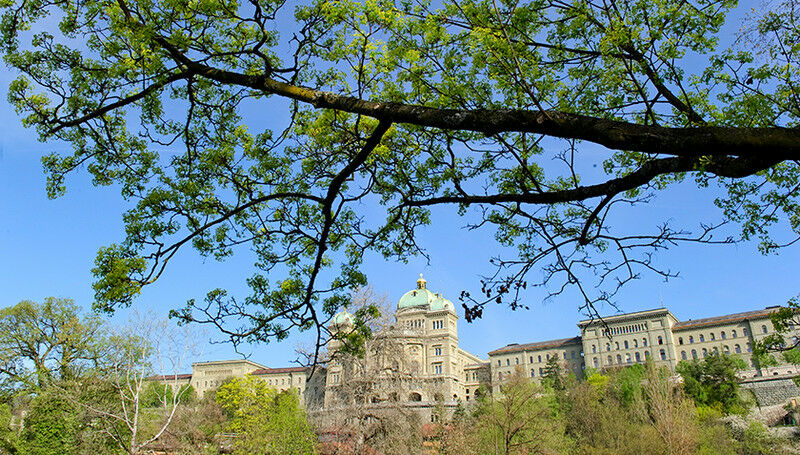
Parliament building, south facade, Bern (Photo: Parliamentary Services 3003 Bern)
Parliament building, south facade, Bern (Photo: Parliamentary Services 3003 Bern) - Whether a hydroelectric power plant is built, a pesticide is banned or a moor is placed under protection - a wide variety of political decisions have an impact on biodiversity. But does biodiversity play any role at all in such decisions? Researchers at Eawag and WSL have investigated this question and examined Swiss policy over the past 20 years. Biodiversity is being increasingly talked about in the media and in public. But are these words also followed by deeds? Is there a biodiversity policy that takes the complexity of the issue into account? "These are important questions, because in order to be able to protect biodiversity, it has to be considered in many different areas, from environmental and agricultural policy to transport and energy policy, and taken into account in legislation," says Ueli Reber, a political scientist at the aquatic research institute Eawag. That is why he and colleagues from Eawag and the Swiss Federal Institute for Forest, Snow and Landscape Research (WSL) analysed federal policy between 1999 and 2018. "We wanted to elucidate the status of biodiversity in politics, how attention to it has developed and in which areas there are still blind spots." To this end, the researchers collected around 440,000 documents - from the transcripts of sessions of the National Council and Council of States to legislative texts and federal court rulings. Using computer-assisted content analysis, they investigated whether the texts relate to biodiversity.
TO READ THIS ARTICLE, CREATE YOUR ACCOUNT
And extend your reading, free of charge and with no commitment.