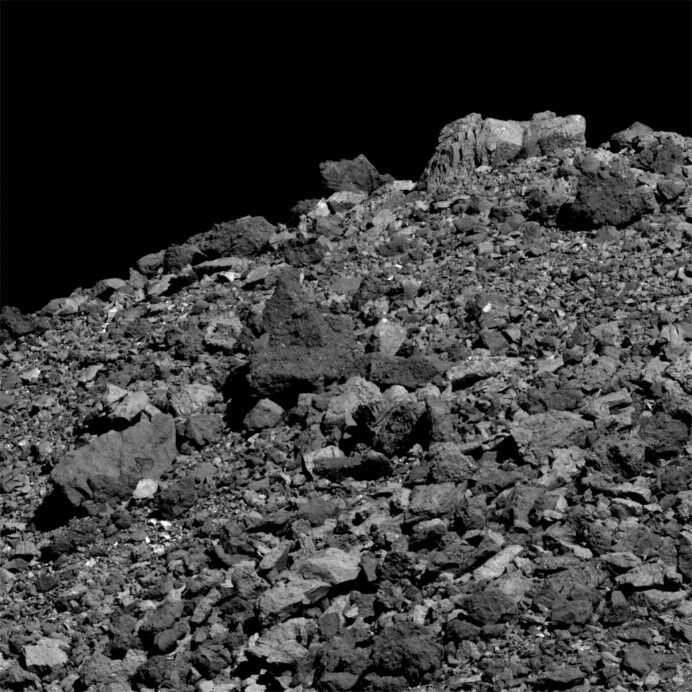
 This picture taken in March 2019 by the OSIRIS-REx spacecraft revealed an abundance of boulders littering the surface of asteroid Bennu.
This picture taken in March 2019 by the OSIRIS-REx spacecraft revealed an abundance of boulders littering the surface of asteroid Bennu. NASA/Goddard Space Flight Center/University of Arizona - There was a surprise in store for NASA's OSIRIS-REx spacecraft as it prepared to land on asteroid Bennu in October 2020 in order to collect samples. Contrary to what astronomers believed, the asteroid's surface was not covered with a layer of fine dust, called regolith. This dust, which blankets the Moon and some asteroids, is formed when thermal shock and meteorite impacts break up surface rocks. However, Bennu's surface was mostly made up of relatively large, bare rocks. Now, an international team led by researchers from the University of Arizona and the CNRS 1 have succeeded in finding an answer to this puzzle. Using a machine learning method, they have shown that the absence of regolith can be explained by the porosity of Bennu's rocks.
TO READ THIS ARTICLE, CREATE YOUR ACCOUNT
And extend your reading, free of charge and with no commitment.
Your Benefits
- Access to all content
- Receive newsmails for news and jobs
- Post ads