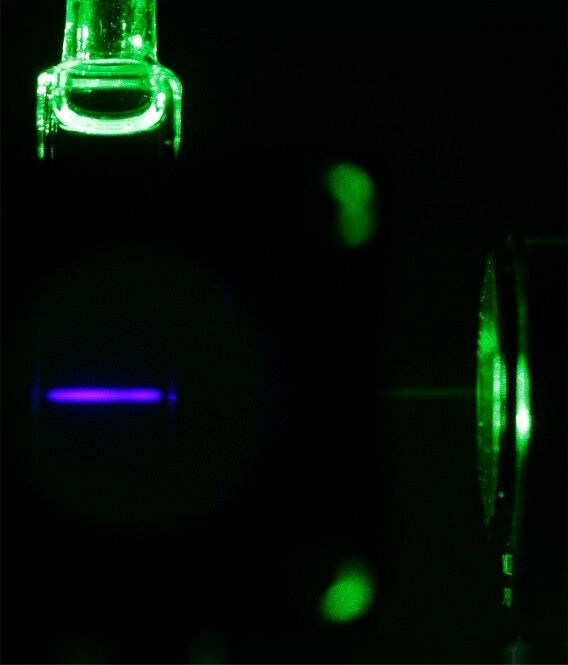
Green-to-blue light upconversion in a solution with a molecular ruby
Scientists in Mainz and Berlin use chromium for efficient green-to-blue photon upconversion. Green-to-blue light upconversion in a solution with a molecular ruby - Sustainable chemical applications need to be able to employ renewable energy sources, renewable raw materials, and earth-abundant elements. However, to date many techniques have only been possible with the use of expensive precious metals or rare earth metals, the extraction of which can have serious environmental impacts. A team of researchers including Professor Katja Heinze and Professor Christoph Kerzig of Johannes Gutenberg University Mainz (JGU) as well as Dr. Ute Resch-Genger of the German Bundesanstalt für Materialforschung und -prüfung (BAM) has now achieved a breakthrough in the use of chromium, an abundant base metal which Heinze's group has been investigating for some time. The new findings show that chromium compounds, also called molecular rubies, can substitute expensive precious metals in photon upconversion. Photon upconversion (UC) is a process in which the sequential absorption of two photons of lower energy leads to the emission of one photon of higher energy. This higher energy photon can in principle be employed to expand the use of low-energy sunlight in solar cells or photochemical reactions which otherwise require UV light for activation.
TO READ THIS ARTICLE, CREATE YOUR ACCOUNT
And extend your reading, free of charge and with no commitment.