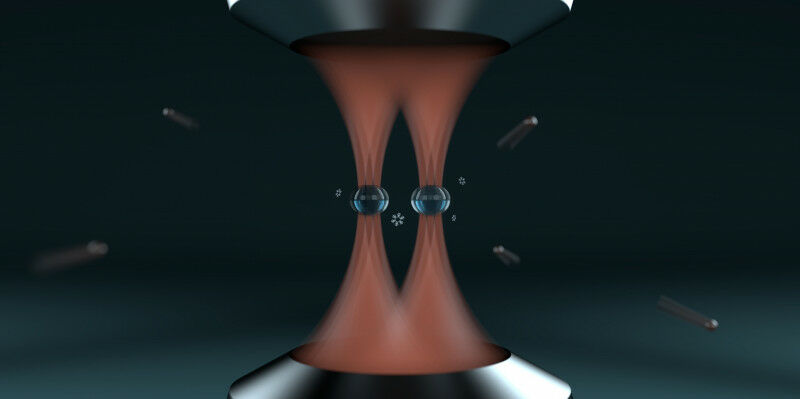
Using focused laser beams (red) the researchers cool two glass spheres to extremely low temperatures. (Photograph: ETH Zürich / Vijayan Jayadev)
Using focused laser beams ( red ) the researchers cool two glass spheres to extremely low temperatures. (Photograph: ETH Zürich / Vijayan Jayadev) - Researchers at ETH have developed a technique to cool several nanoparticles simultaneously to temperatures of just a few thousandths of a degree above absolute zero. This new method can be used to study quantum effects of several nanoparticles and to build highly sensitive sensors. Over the past forty years, physicists have learned to cool increasingly large objects down to temperatures close to the absolute zero: atoms, molecules and, more recently, also nanoparticles consisting of billions of atoms. Whereas one can cool atoms with laser light alone, up to now nanoparticles needed to have an electric charge and had to be manipulated using electric fields for optimal cooling. A team of researchers led by Professor Lukas Novotny at the Department of Information Technology and Electrical Engineering has now developed a technique to trap and cool several nanoparticles independently of their electric charge down to a few millikelvin. This opens up various possibilities to study quantum phenomena of such particles or to build highly sensitive sensors.
TO READ THIS ARTICLE, CREATE YOUR ACCOUNT
And extend your reading, free of charge and with no commitment.