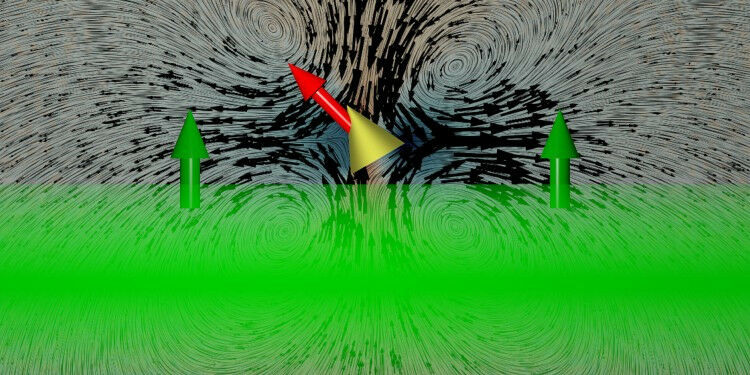
 A conical nanoparticle (gold-coloured) in water. The particle is exposed to an ultrasound wave (green arrows indicate the direction of wave propagation). Because the ultrasound impacts on the particle, a flow field is created in its surroundings (the black arrows in the background show the direction and strength of the flow at various positions). The flow field causes the propulsion of the particle in the direction of the red arrow.
A conical nanoparticle (gold-coloured) in water. The particle is exposed to an ultrasound wave (green arrows indicate the direction of wave propagation). Because the ultrasound impacts on the particle, a flow field is created in its surroundings (the black arrows in the background show the direction and strength of the flow at various positions). The flow field causes the propulsion of the particle in the direction of the red arrow. Münster University - Wittkowski working group For the first time, physicists simulate the propulsion of freely orientable nanoparticles by travelling ultrasound waves / Study published in -ACS Nano - Microscopically tiny nanomachines which move like submarines with their own propulsion - for example in the human body, where they transport active agents and release them at a target: What sounds like science fiction has, over the past 20 years, become an ever more rapidly growing field of research. However, most of the particles developed so far only function in the laboratory. Propulsion, for example, is a hurdle.
TO READ THIS ARTICLE, CREATE YOUR ACCOUNT
And extend your reading, free of charge and with no commitment.
Your Benefits
- Access to all content
- Receive newsmails for news and jobs
- Post ads