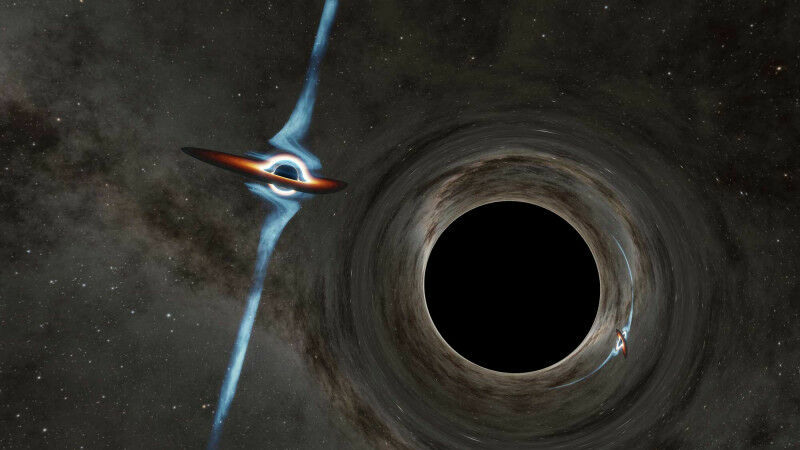
A team of researchers has discovered a pair of black holes orbiting each other 13 billion light-years away. The smaller black hole is in the foreground, and the more massive black hole, with a jet emanating from it and pointed at Earth, is in the background. Image credit: R. Hurt (IPAC)/Caltech
A team of researchers has discovered a pair of black holes orbiting each other 13 billion light-years away. The smaller black hole is in the foreground, and the more massive black hole, with a jet emanating from it and pointed at Earth, is in the background. Image credit: R. Hurt (IPAC)/Caltech Caught in an epic cosmic waltz, two supermassive black holes appear to be orbiting around each other every two years. A team of researchers has discovered the pair of supermassive black holes caught in the act of merging 13 billion light-years away. The two massive bodies are each hundreds of millions of times the mass of our sun and span a distance roughly fifty times the size of our own solar system. When the pair merge in roughly 10,000 years, the collision is expected to shake space and time itself, sending gravitational waves across the universe. The study, which uses University of Michigan data collected at the now-closed U-M Radio Astronomy Observatory at the Peach Mountain Observatory, was led by a team of astronomers at Caltech and includes U-M astronomer and research scientist Margo Aller.
TO READ THIS ARTICLE, CREATE YOUR ACCOUNT
And extend your reading, free of charge and with no commitment.