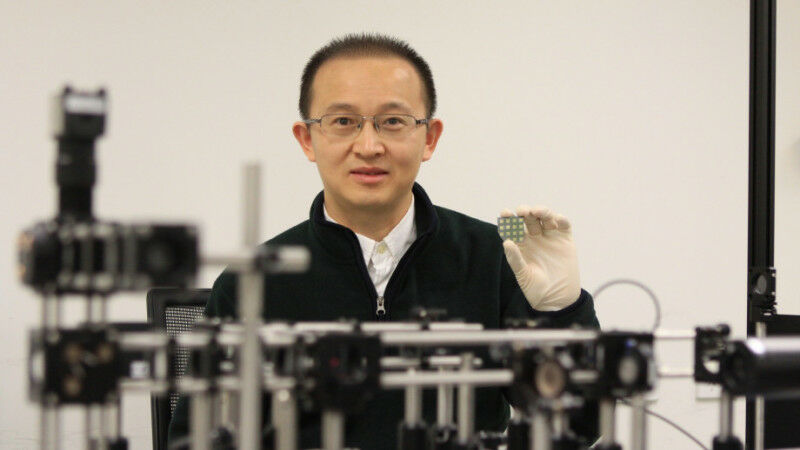
Professor Yuerui (Larry) Lu. Photo: Professor Yuerui Lu/ANU.
Professor Yuerui (Larry) Lu. Photo: Professor Yuerui Lu/ANU. Electrical engineers from The Australian National University (ANU) have demonstrated how to create exciton pairs in a new type of semiconductor structure, paving the way for next generation technologies required for high speed computing, information processing and data communication. The research could lay the foundations for a new generation of smartphones and computers that are blisteringly fast but also consume significantly less energy than current devices. The new technology has been developed by sandwiching together two sheets of bendable monolayer semiconductors and allows interlayer excitons to bind together and form pairs. The research is published in Nature . An interlayer exciton is a quasiparticle made by a negatively charged electron and a positively charged "hole" that are sitting in two different layers.
TO READ THIS ARTICLE, CREATE YOUR ACCOUNT
And extend your reading, free of charge and with no commitment.