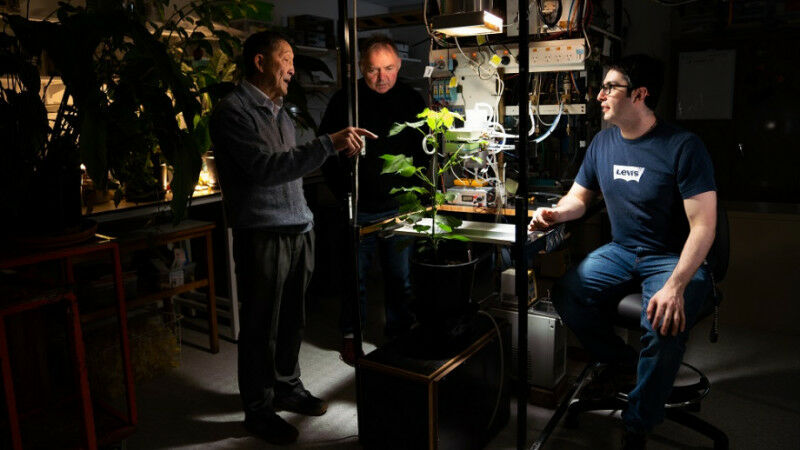
ANU researchers (from left) Dr Chin Wong, Distinguished Professor Graham Farquhar and Dr Diego Marquez. Photo: Tracey Nearmy/ANU
ANU researchers ( from left ) Dr Chin Wong, Distinguished Professor Graham Farquhar and Dr Diego Marquez. Photo: Tracey Nearmy/ANU - Scientists from The Australian National University (ANU) and James Cook University (JCU) have identified an "exquisite" natural mechanism that helps plants limit their water loss with little effect on carbon dioxide (CO2) intake - an essential process for photosynthesis, plant growth and crop yield. The discovery, led by Dr Chin Wong from ANU, is expected to help agricultural scientists and plant breeders develop more water-efficient crops. Study co-author Dr Diego Marquez, from ANU, said the findings will have significant implications for the agricultural industry and could lead to more resilient crops capable of withstanding extreme weather events, including drought. "Plants continuously lose water through pores in the 'skin' of their leaves. These same pores allow CO2 to enter the leaves and are critical to their survival," Dr Marquez said. - - "For every unit of CO2 gained, plants typically lose hundreds of units of water. This is why plants require a lot of water in order to grow and survive. "The mechanism we have demonstrated is activated when the environment is dry, such as on a hot summer day, to allow the plant to reduce water loss with little effect on CO2 uptake." The researchers believe this water preserving mechanism can be manipulated and, in turn, may hold the key to breeding more water-efficient crops.
TO READ THIS ARTICLE, CREATE YOUR ACCOUNT
And extend your reading, free of charge and with no commitment.