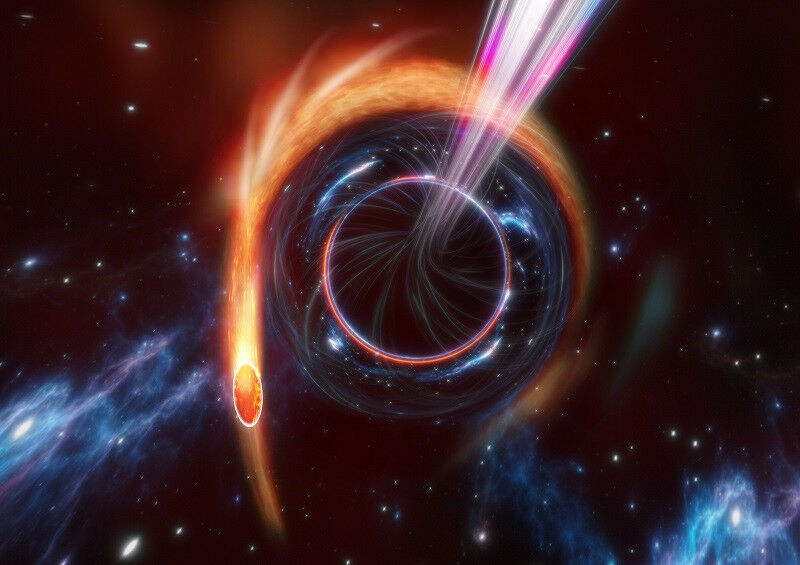
 Image of AT2022cmc © Carl Knox - OzGrav, ARC Centre of Excellence for Gravitational Wave Discovery, Swinburne University of Technology
Image of AT2022cmc © Carl Knox - OzGrav, ARC Centre of Excellence for Gravitational Wave Discovery, Swinburne University of Technology - For the first time in over a decade, scientists from the CNRS and the Institut de radioastronomie millimétrique 1 , together with international colleagues, have observed a tidal disruption event (TDE) with jets, a very rare occurrence resulting from an encounter between a star and a supermassive black hole (SMBH). When such an event occurs, gravity disrupts the star: its matter breaks apart and spins quickly before being submerged by the black hole. Occasionally, the latter emits jets of matter travelling at slightly less than the speed of light. Such a rare emission, observed by the research teams and named AT2022cmc, is the subject of an article published on 30 November in the journal Nature. Researchers used methods developed since the last time a TDE was observed in 2012, including the Zwicky Transient Facility: a powerful camera coupled with special software that allows scientists to detect and signal unusual events in real time. Rapid coordination between the research teams, each of which is specialised in a specific form of observation, was key to viewing AT2022cmc. The NOEMA radio telescope 2 , for example, helped characterise the source of the event, and a spectrograph installed on the ESO Very Large Telescope was used to assess the origin of this rare phenomenon, estimated to be 8.5 billion light-years from Earth at the centre of its host galaxy.
TO READ THIS ARTICLE, CREATE YOUR ACCOUNT
And extend your reading, free of charge and with no commitment.
Your Benefits
- Access to all content
- Receive newsmails for news and jobs
- Post ads