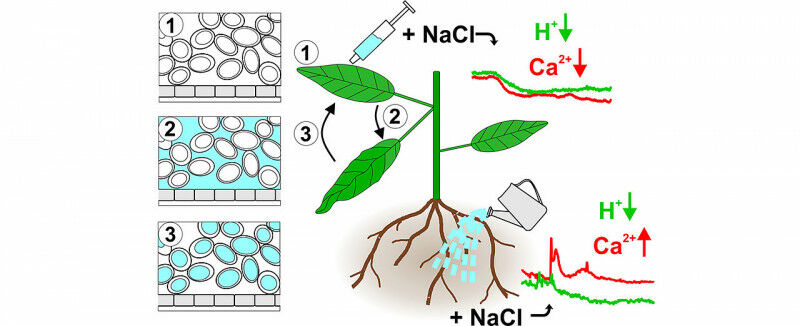
Flooding the intercellular spaces with salt causes the leaf to sink temporarily (1 - 2). After disposal of the salt in the vacuole (3), the leaf resumes its initial position (1). The application of salt causes a decrease in the cytoplasmic calcium ion and proton concentration in the leaf, but an increase in calcium ions in the root.
Flooding the intercellular spaces with salt causes the leaf to sink temporarily (1 - 2). After disposal of the salt in the vacuole (3), the leaf resumes its initial position (1). The application of salt causes a decrease in the cytoplasmic calcium ion and proton concentration in the leaf, but an increase in calcium ions in the root. Plant leaves can cope with much higher salt concentrations than roots. The underlying mechanism may help to develop more salt-tolerant crops. When there is a lack of water, heat or intensive irrigation, the level of common salt (sodium chloride) in the soil increases. However, most crops are sensitive to salt.
TO READ THIS ARTICLE, CREATE YOUR ACCOUNT
And extend your reading, free of charge and with no commitment.