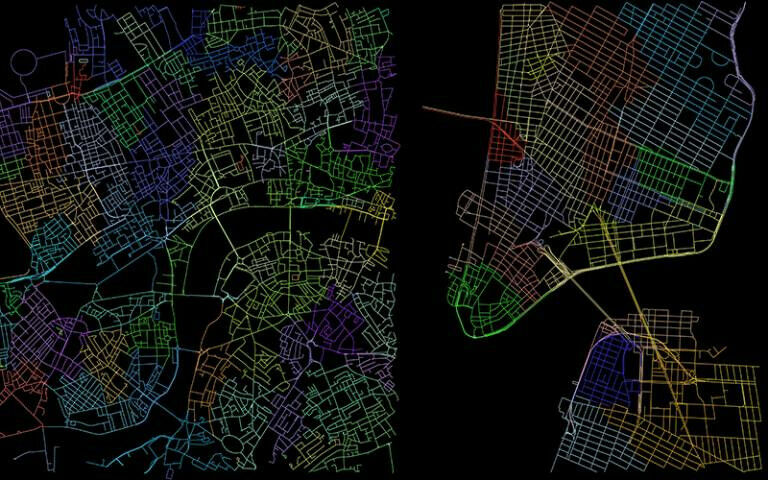
London and New York City street networks - The more organic, complex (entropic) street layout of London (left) compared to the grid layout of New York City. Created by co-authors Dr Antoine Coutrot (CNRS) and Ed Manley (University of Leeds).
London and New York City street networks - The more organic, complex (entropic) street layout of London ( left ) compared to the grid layout of New York City. Created by co-authors Dr Antoine Coutrot (CNRS) and Ed Manley (University of Leeds) . People who grew up in rural or suburban areas have better spatial navigation skills than those raised in cities, particularly cities with grid-pattern streets, finds a new study led by researchers at UCL, University of Lyon and the University of East Anglia (UEA). The researchers also found that people whose home cities had grid layouts were slightly better at navigating similarly organised street patterns, despite having poorer performance overall, as early childhood environments influence not only navigation ability, but navigation styles as well. The study a citizen science venture designed for neuroscience research, created by Deutsche Telekom in partnership with Alzheimer's Research UK, UCL, UEA and game developers Glitchers. Lead researcher Professor Hugo Spiers (UCL Psychology & Language Sciences) said: "We found that growing up outside of cities appears to be good for the development of navigational abilities, and this seems to be influenced by the lack of complexity of many street networks in cities. "In our recent research, we have found that people's spatial navigation skills decline with age, starting in early adulthood.
TO READ THIS ARTICLE, CREATE YOUR ACCOUNT
And extend your reading, free of charge and with no commitment.