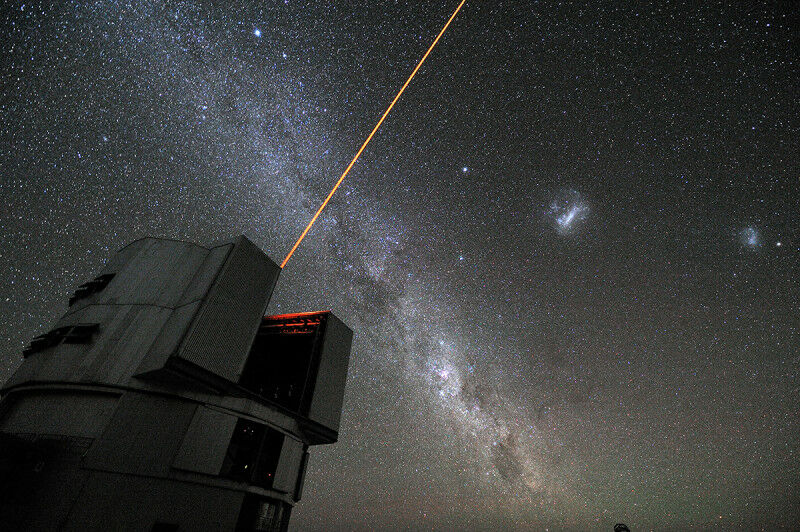
 The VLT’s Laser Guide Star: A laser beam launched from VLT’s 8.2-metre Yepun telescope crosses the majestic southern sky and creates an artificial star at 90 km altitude in the high Earth’s mesosphere. The Laser Guide Star (LGS) is part of the VLT’s Adaptive Optics system and it is used as reference to correct images from the blurring effect of the atmosphere.
The VLT's Laser Guide Star: A laser beam launched from VLT's 8.2-metre Yepun telescope crosses the majestic southern sky and creates an artificial star at 90 km altitude in the high Earth's mesosphere. The Laser Guide Star (LGS) is part of the VLT's Adaptive Optics system and it is used as reference to correct images from the blurring effect of the atmosphere. ESO / G. Hüdepohl (atacamaphoto.com) - Astronomical observations from ground-based telescopes are sensitive to local atmospheric conditions. Anthropogenic climate change will negatively affect some of these conditions at observation sites around the globe, as a team of researchers led by the University of Bern and the National Centre of Competence in Research (NCCR) PlanetS report. The quality of ground-based astronomical observations delicately depends on the clarity of the atmosphere above the location from which they are made. Sites for telescopes are therefore very carefully selected. They are often high above sea level, so that less atmosphere stands between them and their targets.
TO READ THIS ARTICLE, CREATE YOUR ACCOUNT
And extend your reading, free of charge and with no commitment.
Your Benefits
- Access to all content
- Receive newsmails for news and jobs
- Post ads