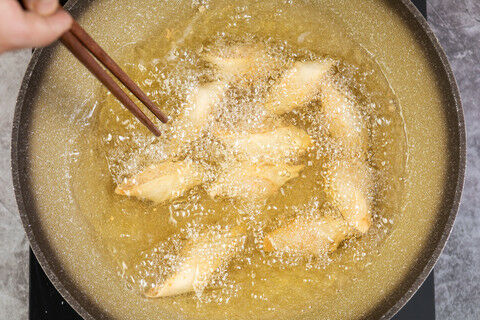
(© Image: Dreamstime) - Researchers find the physics of frying food far more complex than anticipated - By - Cooks throughout Asia put moist bamboo chopsticks into oil in a frying pan, watching the bubbles that form and listening to the sizzling sound they make as they burst to gauge the perfect cooking temperature. An international team of researchers used the technique as inspiration to learn about the complex physics behind wet chopsticks hitting hot oil. "Many cookbooks teach this technique and it is widely used, but when we searched the academic literature, we couldn't find any detailed scientific explanations," said Zhao Pan , a mechanical and mechatronics engineering professor at the University of Waterloo. "We set out to provide one." "Members of our team speak seven different languages, but we couldn't find any scientific investigation, and no one knows the history of the trick," added lead author Akihito Kiyama of Utah State University. The project involved experiments placing wet paper, moistened chopsticks and water droplets in hot oil, with the results recorded using sensitive microphones and high-speed cameras. Researchers found the physics of frying food far more complex than they anticipated. To simplify their tests, they used moist pieces of paper and, later, water droplets as stand-ins for actual food.
TO READ THIS ARTICLE, CREATE YOUR ACCOUNT
And extend your reading, free of charge and with no commitment.
Your Benefits
- Access to all content
- Receive newsmails for news and jobs
- Post ads