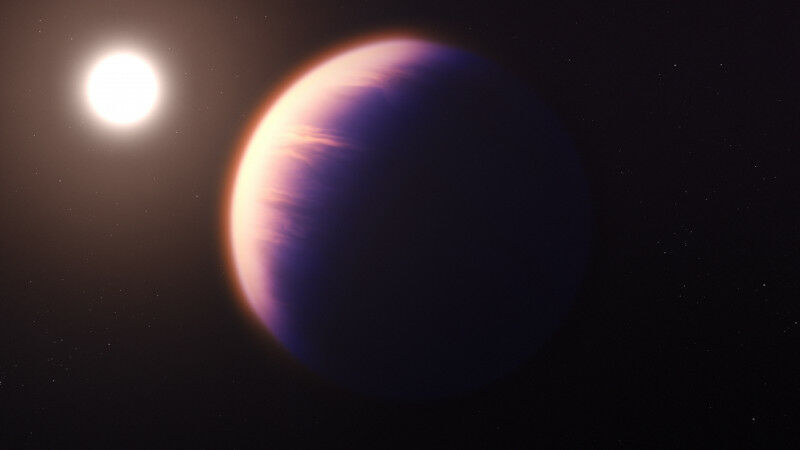
 This illustration shows what exoplanet WASP-39 b could look like, based on current understanding of the planet. This illustration is based on indirect transit observations from Webb as well as other space and ground-based telescopes. Webb has not captured a direct image of this planet.
This illustration shows what exoplanet WASP-39 b could look like, based on current understanding of the planet. This illustration is based on indirect transit observations from Webb as well as other space and ground-based telescopes. Webb has not captured a direct image of this planet. NASA, ESA, CSA, Joseph Olmsted - The James Webb Space Telescope delivers a sensation right away with its first scientific result: for the first time, CO2 has been conclusively detected in the atmosphere of a planet outside the solar system. Researchers from the University of Bern, the University of Geneva and the National Centre of Competence in Research (NCCR) PlanetS are involved in the study. Due to its role in regulating the climate, carbon dioxide is a central component of the Earth's atmosphere. Being able to clearly detect the molecule in the atmosphere of distant exoplanets is therefore an essential step in the search for life-friendly worlds.
TO READ THIS ARTICLE, CREATE YOUR ACCOUNT
And extend your reading, free of charge and with no commitment.
Your Benefits
- Access to all content
- Receive newsmails for news and jobs
- Post ads