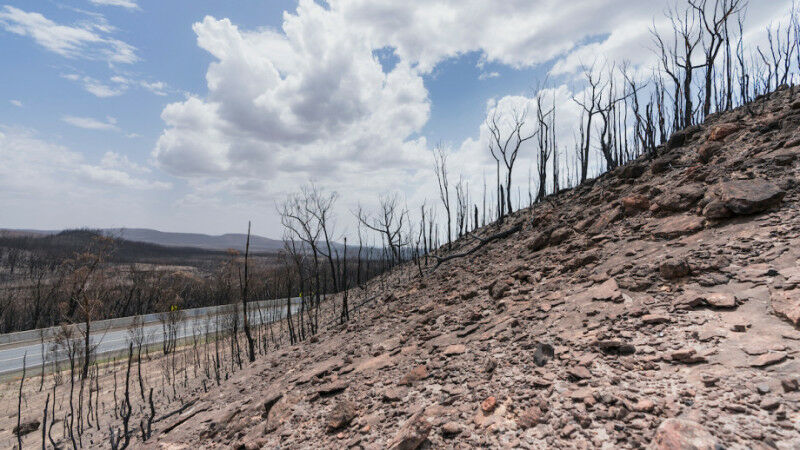
Devastation in Moreton National Park after the Currowan fire of January 2020.
Devastation in Moreton National Park after the Currowan fire of January 2020. An analysis of the fire footprint of the 2019-2020 Black Summer bushfires has found logging elevated the risk of high-severity fires. A team of Australian researchers, including Professor David Lindenmayer and Dr Chris Taylor from The Australian National University (ANU), completed the study. The Black Summer bushfires burned through more than 24 million hectares and destroyed thousands of homes. Professor Lindenmayer said while weather conditions had the biggest influence on the severity of the fires, these effects were amplified by logging. According to Professor Lindenmayer, logged forests always burn at greater severity than intact forests. "Logging increases the probability of canopy damage by five to 20 per cent and leads to long-term elevated risk of higher severity fire," he said. "On the other hand, if disturbance due to logging is minimised, canopy damage can be reduced, in turn reducing the risk of uncontrollable fires." Dr Chris Taylor from ANU said : " Even in mild fire weather, logged forests were more likely to suffer high severity fire than unlogged forests under more severe weather conditions." Researchers from ANU, Curtin University, Macquarie University and University of Queensland contributed to the study.
TO READ THIS ARTICLE, CREATE YOUR ACCOUNT
And extend your reading, free of charge and with no commitment.