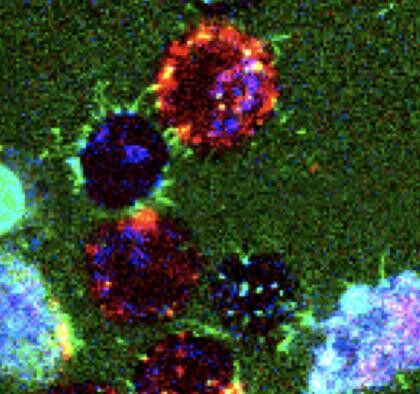
Nanopipes connected to a cell
Nanopipes connected to a cell - Working on microscopic pipes only a millionth as wide as a single strand of human hair, Johns Hopkins researchers have engineered a way to ensure that these tiniest of pipes are safe from the tiniest of leaks. Leak-free piping, made with nanotubes that self-assemble, self-repair, and can connect themselves to different biostructures, is a significant step toward creating a nanotube network that one day might deliver specialized drugs, proteins, and molecules to targeted cells in the human body. The highly precise measurements are outlined today in Science Advances . "This study suggests very strongly that it's feasible to build nanotubes that don't leak using these easy techniques for self-assembly, where we mix molecules in a solution and just let them form the structure we want," said Rebecca Schulman , an associate professor of chemical and biomolecular engineering at Johns Hopkins who co-led the research. "In our case, we can also attach these tubes to different endpoints to form something like plumbing." The team worked with tubes roughly seven nanometers in diameter-about two million times smaller than an ant-and several microns long, or about the length of a dust particle. The method builds on an established technique that repurposes pieces of DNA as building blocks to grow and repair the tubes while enabling them to seek out and connect to specific structures. Previous studies have designed similar structures called nanopores.
TO READ THIS ARTICLE, CREATE YOUR ACCOUNT
And extend your reading, free of charge and with no commitment.