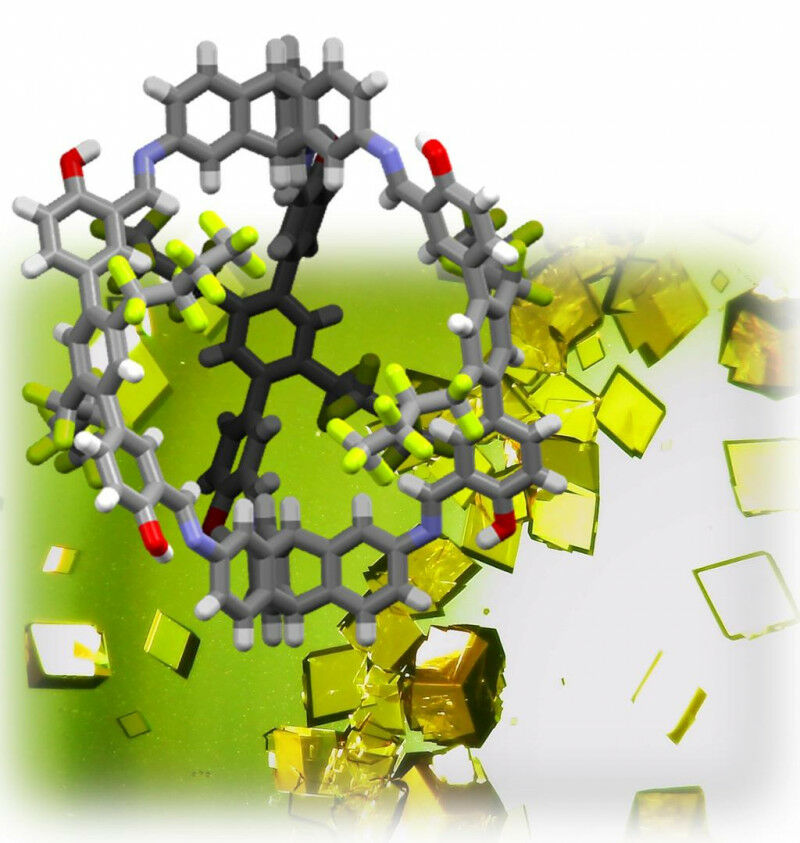
 In the background: light microscopy images of the single-crystal structures of the shape-persistent organic cage compound. In the front: ball-and-stick model of the single-crystal structure, grey: carbon, white: hydrogen, red: oxygen, blue: nitrogen, green: fluorine. |
Heidelberg researchers develop new crystalline materials that adsorb polyfluorinated hydrocarbons on their surface. In the background: light microscopy images of the single-crystal structures of the shape-persistent organic cage compound. In the front: ball-and-stick model of the single-crystal structure, grey: carbon, white: hydrogen, red: oxygen, blue: nitrogen, green: fluorine. Michael Mastalerz - Emissions of greenhouse gases contribute significantly to global warming. Not only carbon dioxide (CO2) but also fluorine-containing gases - including so-called peror polyfluorinated hydrocarbons, or PFCs - have a significant share in this development. Researchers at the Institute of Organic Chemistry of Heidelberg University led by Michael Mastalerz recently developed new crystalline materials that can selectively adsorb the molecules of such carbon-fluorine bonds. The Heidelberg researchers hope that these porous crystals may be useful for targeted binding and recovery of PFCs.
TO READ THIS ARTICLE, CREATE YOUR ACCOUNT
And extend your reading, free of charge and with no commitment.
Your Benefits
- Access to all content
- Receive newsmails for news and jobs
- Post ads