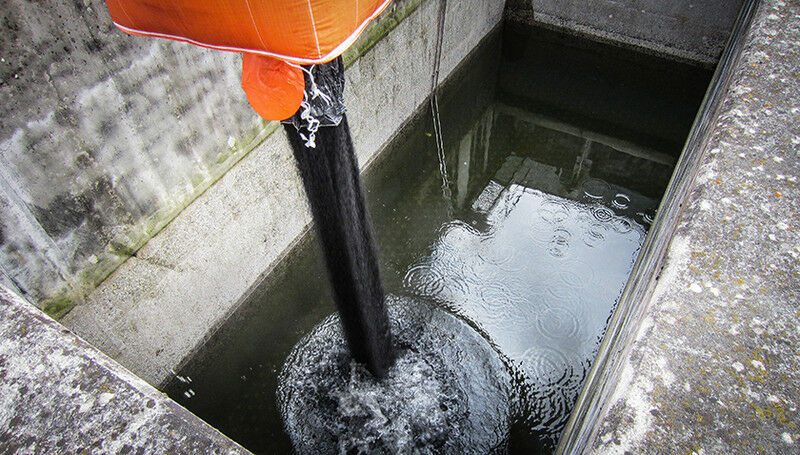
Filling granular activated carbon into a sand filter cell at the Furt-Bülach WWTP. (Photo: J. Fleiner)
Filling granular activated carbon into a sand filter cell at the Furt-Bülach WWTP. (Photo: J. Fleiner) - For the elimination of trace substances at wastewater treatment plants (WWTP), granular activated carbon (GAC) is also available as an alternative treatment option to ozonation and the powdered activated carbon process (PAC). In contrast to the high energy consumption in ozonation (electrical energy to generate ozone and liquid oxygen), the energy-intensive production and CO2-footprint of carbon (starting raw materials, process energy) have an impact on activated carbon treatment. The main advantage of using activated carbon is that, unlike ozonation, the micropollutants are not oxidised but adsorbed and thus no transformation products are formed. The use of activated carbon can also achieve a significant DOC (dissolved organic carbon) reduction in the effluent of the WWTP, which can be an additional advantage when upgrading or retrofitting the wastewater treatment plant. Pilot studies show: GAC efficiently removes micropollutants. With two pilot studies now summarised in the current A&G at the Furt-Bülach and Glarus WWTPs, Eawag, in collaboration with many partners, has been able to demonstrate that the process of space filtration with granular activated carbon is suitable for efficiently removing micropollutants from municipal wastewater while complying with statutory requirements.
TO READ THIS ARTICLE, CREATE YOUR ACCOUNT
And extend your reading, free of charge and with no commitment.