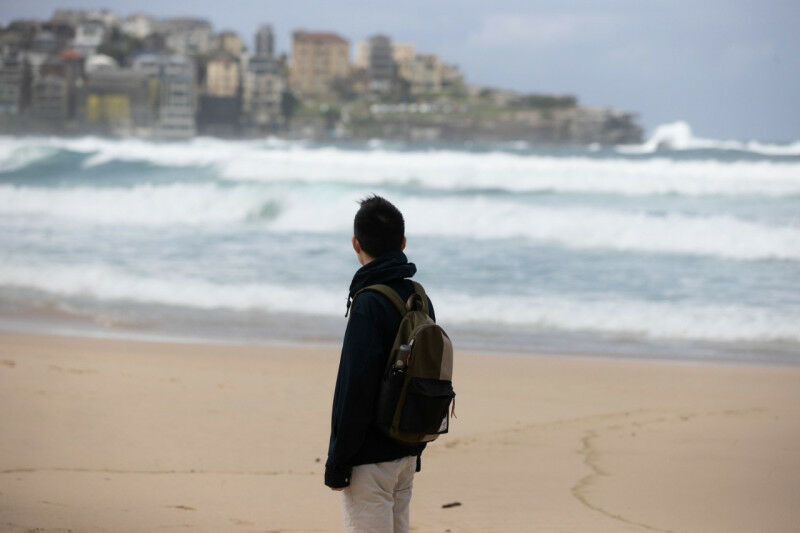
PhD candidate Yuchen He looking out at a rough swell hitting Bondi Beach. Image: Louise Cooper, University of Sydney
PhD candidate Yuchen He looking out at a rough swell hitting Bondi Beach. Image: Louise Cooper, University of Sydney Ocean waves up to 30 metres that seemingly appear at random have long inspired legend and stumped scientists. Now, researchers at the University of Sydney and Kyoto University are unravelling their mysteries. Research published in Physical Review Letters by University of Sydney and Kyoto researchers has found that extreme or 'rogue' ocean waves - colossal walls of water that seemingly appear at random and have the potential to destroy marine infrastructure, carve out coastlines and even threaten life - could be more frequent in multi-directional wave formations than previously expected. These enormous "rogue" swells have long captured the imagination. Although mathematical modelling has helped scientists and engineers hypothesise different causes, since the 1980s it was thought they were caused by either wave overlap (the superposition principle) or a mechanism which triggers a rogue wave (modulation instability) in one-directional wave systems. In multi-directional systems, known as crossing wave formations or crossing seas, modulation instability was believed to be inactive, rendering extreme waves rare or impossible in these conditions.
TO READ THIS ARTICLE, CREATE YOUR ACCOUNT
And extend your reading, free of charge and with no commitment.