The new study opens new perspectives for the design of new opioid analgesics without addictive effects.
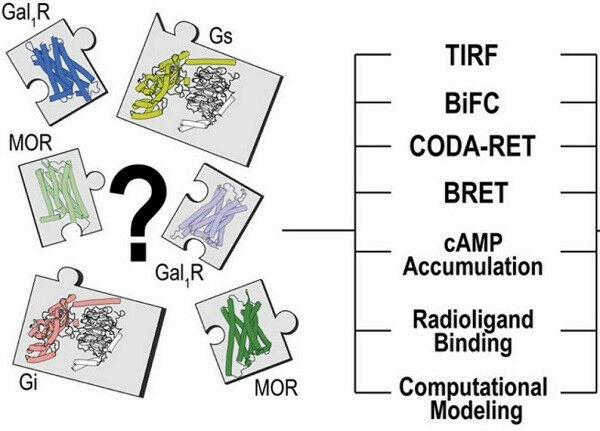
The new study opens new perspectives for the design of new opioid analgesics without addictive effects. A study published in the journal Pharmacological Research reveals the oligomeric molecular structure of the MOR-Gal1R complex, a component present in the brain which is involved in the analgesic and addictive effects of certain opioids. The study includes the participation of the experts Vicent Casadó, Estefanía Moreno and Verònica Casadó-Anguera, from the Molecular Neuropharmacology Research Group of the Faculty of Biology and the Institute of Biomedicine of the University of Barcelona (I ). The study is coordinated by the experts Vicent Casadó (UB-IBUB), Leonardo Pardo (UAB), Leigh Daniel Plant (Boston Northeastern University, United States) and Sergi Ferré (National Institute on Drug Abuse, NIH, United States).This preclinical study, based on the use of cellular models and leading biophysical, biochemical and pharmacological techniques (total internal reflection fluorescence microscopy, TIRF), has been distinguished for its scientific interest in the of the NIH's National Institute on Drug Abuse. Receptors, macrostructures and pharmacological activity Gal1R and MOR receptors belong to the family of G protein-coupled receptors (GPCRs) that take part in the transduction of different cellular signals and the control of essential cell functions. These structures can form dimers —homodimers or heterodimers— that determine functional and pharmacological properties that are different from those of the individual components.
TO READ THIS ARTICLE, CREATE YOUR ACCOUNT
And extend your reading, free of charge and with no commitment.