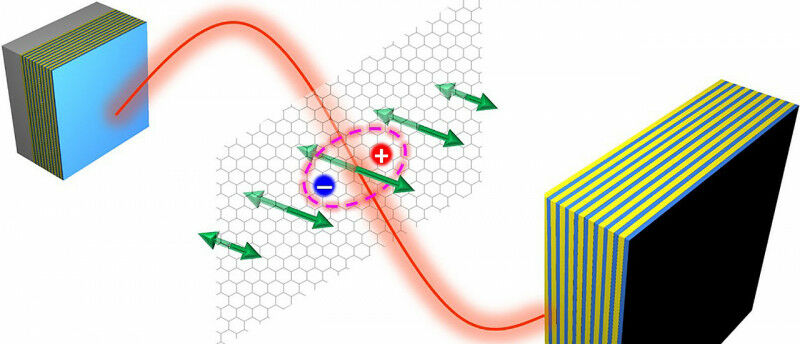
Coupling of phonon (green), exciton (pink), and photon of a microcavity (red) in a 2D material. (Image: Donghai Li / Universität Würzburg)
Coupling of phonon ( green ), exciton ( pink ), and photon of a microcavity ( red ) in a 2D material. (Image: Donghai Li / Universität Würzburg) 02/24/2022 - Würzburg researchers have highlighted and quantified a three-fold coupling between exciton, photon, and phonon in a microcavity with embedded two-dimensional materials. Atomically thin two-dimensional (2D) materials can provide highly interesting excitonic properties, which render them an attractive platform to explore polaritonic physics. In the literature, a variety of inorganic exciton-polariton systems have been studied experimentally and described theoretically using the broadly accepted model of two coupled oscillators, where only the coupling between excitons and cavity photons is considered. Now, Donghai Li and a group of researchers from Julius-Maximilians-Universität (JMU) Würzburg in Bavaria, Germany, have found that placing 2D semiconductors in microcavities can lead to a strong interaction between not just excitons and cavity photons but also with phonons. The team believes that their results could shift the paradigm of exciton-polariton physics in 2D materials by highlighting and quantifying the role of phonons therein. Novel method with temporal resolution of 20 femtoseconds .
TO READ THIS ARTICLE, CREATE YOUR ACCOUNT
And extend your reading, free of charge and with no commitment.