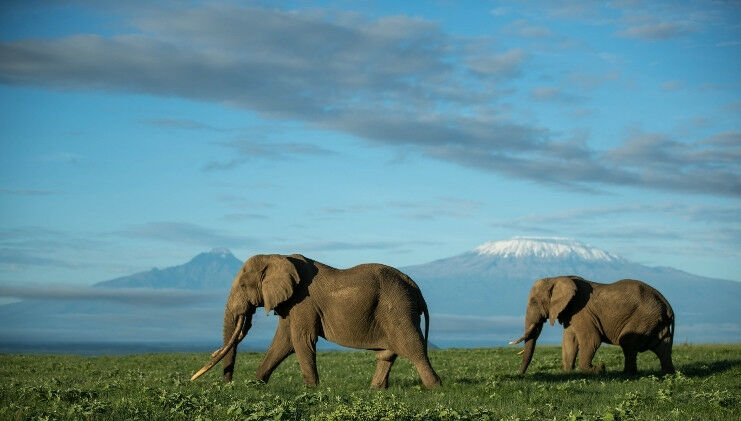
Big-tusked elephants safe in the Amboseli ecosystem at the foot of Kilimanjaro, Kenya. Copyright: Max Melesi on behalf of Koobi Carbon
Big-tusked elephants safe in the Amboseli ecosystem at the foot of Kilimanjaro, Kenya. Copyright: Max Melesi on behalf of Koobi Carbon 64 million km2 - 44% of Earth's land area - requires conservation to safeguard biodiversity. This is revealed in a new study led by biologists of the University of Amsterdam, that was published on 3 June 2022 in the prestigious journal Science. The international research team used advanced geospatial algorithms to map the optimal areas for conserving terrestrial species and ecosystems across the world. They further used spatially explicit land-use scenarios to quantify how much of this land is at risk from human activities by 2030. Home of 1.8 billion people. Lead author James R. Allan from the University of Amsterdam (UvA): 'Our study is the current best estimate of how much land we must conserve to stop the biodiversity crisis.
TO READ THIS ARTICLE, CREATE YOUR ACCOUNT
And extend your reading, free of charge and with no commitment.