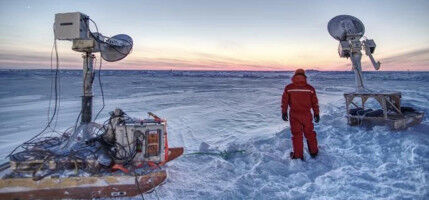
Alert Research Station, Canada ,1 June 2016.
Alert Research Station, Canada ,1 June 2016. Kevin Rawlings - Scientists at EPFL and the Paul Scherrer Institute (PSI) have studied the chemical composition and origin - whether natural or anthropogenic - of aerosols in a region spanning from Russia to Canada. Their findings provide unique insights for helping researchers better understand climate change in the Arctic and design effective pollution-mitigation measures. The work was made possible thanks to the joint effort of scientists from three continents. The tiny particles suspended in the air known as aerosols play an important role in heating and cooling our planet, but their effects still aren't fully understood. The particles can occur naturally, such as from volcanoes, forests and oceans, or be produced by human activity, such as fossil-fuel combustion and industrial manufacturing. They interact with solar radiation, either reflecting it back out into space and lowering the Earth's temperature, or absorbing it and raising the temperature.
TO READ THIS ARTICLE, CREATE YOUR ACCOUNT
And extend your reading, free of charge and with no commitment.
Your Benefits
- Access to all content
- Receive newsmails for news and jobs
- Post ads