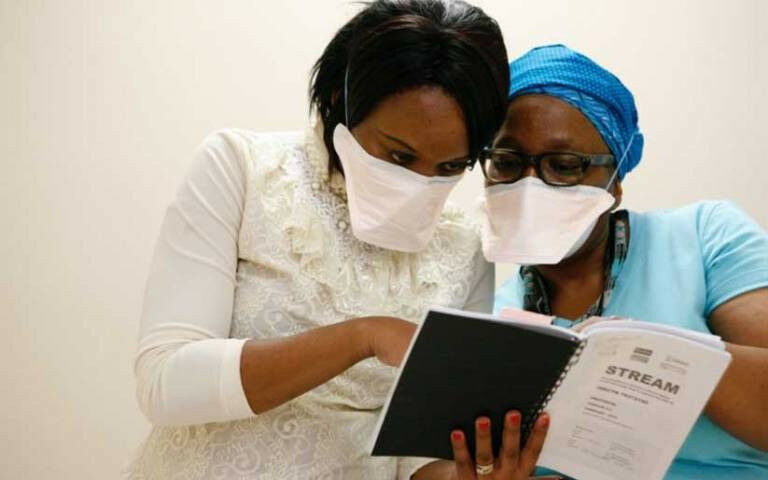
Study team members at King Dinuzulu Hospital in Durban, South Africa, review trial requirements in the STREAM protocol.
Study team members at King Dinuzulu Hospital in Durban, South Africa, review trial requirements in the STREAM protocol. Two treatment regimens for multidrug-resistant tuberculosis (TB), containing the first new drug to have been discovered for the disease in 40 years, are more effective than a previously recommended treatment, according to results from a global trial led by UCL researchers. The study, published by The Lancet , found that a six-month treatment regimen including injections and a nine-month regimen taken only in tablets, both of which used the new drug bedaquiline, were more effective than a nine-month regimen that until two years ago was regarded as the best standard of care. The findings are the latest results from the STREAM randomised clinical trial - the world's largest clinical trial for multidrug-resistant TB, involving 1,000 patients in eight countries. This stage of the trial, which is sponsored by Vital Strategies, was conducted in Ethiopia, Georgia, India, Moldova, Mongolia, South Africa and Uganda. Worldwide cases of TB and multidrug-resistant TB increased in 2021, coinciding with disruption caused by the Covid-19 pandemic, ending many years where the disease was in decline. Professor Sarah Meredith (MRC Clinical Trials Unit at UCL), co-chief investigator and medical lead for STREAM, said: "There is an urgent need for effective, short, and easy-to-administer treatment regimens for multidrug-resistant TB.
TO READ THIS ARTICLE, CREATE YOUR ACCOUNT
And extend your reading, free of charge and with no commitment.